Showing posts with label sexual assault. Show all posts

Monday, May 17

Empowering for you and me

“Anthropology was the science that gave her the platform from which she surveyed , scolded and beamed at the world.” Jane Howard on Margaret Mead

That's how I always felt about anthropology. I felt connected to the art by being about to learn about the world as wholly as possible. Feeling that we need to understand this world before we can help it, development research was a great way to do so. I imagined myself working for a research institute or the research department of an NGO, personally interviewing the people we want to help and finding out how we can help them. That was the drive behind this scholarship: to learn about programs that try to empower women and ask the women themselves how they want to be empowered.

Doing this work is another story. I enjoy interviewing survivors of sexual violence, because I learn about where they come from, what kind of programs they seek for empowerment and what they're dreams are for the future. With this information, I was hoping to publish a paper discussing their needs so better programs can be created. But during all the interviews, I felt I left them just as vulnerable as they were before. I began to feel that I was taking something from them, their story, a piece of them, to use for some high language, post modern academic paper that they will never see nor understand. To add insult to injury, most people who makes decisions on empowerment programs would never consider my findings because they are too wrapped up in what donors want anyway.

Where's the empowerment.. for anyone? I feel I left them not changing anything, leaving them as powerless and as scared of their future as were before I came. I can give them love, of course that helps, I'll always believe that. But that's not a tool they can hold onto, that's a feeling that will fade once I leave. I may have touched some lives, but my work is not sustainable. And in all honesty, where's the empowerment for me? I have felt powerless this entire trip, lost in the colossal mess of Bangladesh's corruption and violence. There were times I lost interest in my work completely because what was the point?

But this weekend, for the first time in the last 10 months, I finally felt I did something right.

My roommate Saba has self-defense training that she attended in India. Looking at the materials, I fell in love: physical and mental self-defense techniques and positive confidence building in a 2-3 day workshop with a group of women only. I begged Saba over a month to let me do a few workshops with her before I leave. While we're still in the process of planning with a few NGOs and universities, we held one 2-day workshop in our living room this past weekend with 8 of our girlfriends.

I never was so happy this entire trip. Combining my own personality traits with my knowledge on sexual assault, I was able to teach other women (our friends) why we face such tragedies as women in patriarchal societies. With Saba's help, we trained our friends how to escape from an attacker by hitting the the most vulnerable parts on a human body. We talked with them about how to define and assert their boundaries. We shared tips in positive personal decision-making and how women overcome the sexist barriers in front of them. It was only two days, it was just our friends (which, most of them are already quite aware of gender violence and are already pro-feminist).. but I felt so f-in good! What I loved was that personal feeling of empowerment being able to empower others. We ended the workshop not knowing how much they will remember, but at least we put these techniques out there and created a safe space for women to share all the awful experiences they keep to themselves. I really loved being a trainer.

So this is my career path: become a trainer on women's empowerment. Who knows where that exactly will lead, training companies on sexual harassment to sex education to confidence building techniques for young girls. I've found several promising organizations in the new city I'm moving to in September. Finally, I'm excited about my future, my empowering future, again.

Wednesday, April 21

"Isn't that rape?"

I'm livid. Personally livid.

As a researcher who studies gender issues and sexual violence in developing countries, I come to hear of some horrifying and disgusting things. But truth be told, I've been getting better at numbing myself to it. It's easier to push into the back of my brain and focus on my work. A lot of stories don't even shock me anymore (like when I came to find that brothels here stick freshly boiled eggs up sex worker's vagina's to punish them). Don't get me wrong, I'm still overwhelmingly angered that gender violence and discrimination is STILL occurring in the goddamn 21st century--but nothing surprises me anymore. Also, most of the time I'm talking to women who escaped and are now with an NGO, (hopefully) out danger. Maybe distancing myself is the only way I can continue with my work.

But it's a whole new set of emotions burst through that wall when something happens to someone you know.

I was supposed to hang out with my good friend yesterday but she cancelled. When I asked her why, she said that her family suddenly informed her that they have a marriage proposal for their 17 year-old daughter (my friend's niece). My friend has been paying her niece's school fees because her brother and his wife aren't working but are living on her family's land. I started to freak out, I thought she wanted to go to college. "I'm going there to meet him and ask her what she wants," my friend responded. I knew I regretted asking: "How old is he?" "35." You do the math.

I spoke to my friend today: "Well, my niece is getting married today." Restraining my fit of rage I ask her, "What did she say?"

"Well she said, 'Why not?' Amanda, she isn't allowed to leave the house now. My brother keeps her inside. She isn't allowed to go out and talk with her friends. She thinks that maybe when she married, her parents can't say anything and she'll have more freedom. She is miserable now, might as well try something new."

I sighed, "I still don't understand why a 35 year-old wants to marry a child."

"For the sex, Amanda. What else?"

"Isn't that rape?"

"Not here."

I know the gender imbalance of her country upsets her, but she just brushes it off as normal. I just can't accept it: because no woman wants that as a normal life, wants marriage as her only choice of escaping tyrant parents. 'Choice'--a word she doesn't know.

I've met this niece at a family gathering, she's sweet. It's just too close to home. It's repulsive and a violation of who we are as humans.

Thursday, April 15

Tangail's Brothel and Sex Work: The "At Least" Sydrome

Black and red smeared eyes peered out between the curtains of their rooms. Some women’s faces were painted white as a Geisha, dressed in vibrant, sparkly skirts. We didn’t know if their make-up was to appear more enticing to customers, or to disguise who they are under a mask.

Despite all the color and glamour, this was a dark place.

Diya and I took a trip through Bangladesh’s oldest brothel in Tangail. Walking through the small alleys, it was similar to a dirty, slum. The ground is the wastebasket and everything reeks of various human fluids. Houses (single room shacks) are practically on top of one another, sharing walls as apartment buildings. There’s no privacy with curtains for doors and outdoor bathrooms. The narrow alleys are filled with sex workers waiting for clients—and clients just dawdling, chatting with shopkeepers selling soda and chips, watching with televisions. It’s own self-sustaining community with food, shelter and water pumps. People could stay inside for weeks without needing to go outside the brothel. Diya turned to me at one point: “This is the strangest place I’ve ever been.”

It was only so uncomfortable knowing what goes on behind these billowing curtains. Shirtless men peered out from the beds, staring at us foreigners unashamed. Honestly, I couldn’t even look at the men. To the women, I tried to smile but I felt intrusive walking in on their work and home space. I didn't take photos for that reasons. And it was mid-day.

It was additionally heartbreaking after hearing the personal stories of the women. I don’t want to sensationalize their lives in this blog, but I do want to create awareness. Some women cried to us during their interviews, sharing how their parents abandoned them or they were sold into the brothel. One woman was so small, ten years old, that she wasn’t even menstruating when she was forced to have sex. Her body was so young and fragile her hip broke when one man was penetrating her. Some girls look (and are) so young that some madams (women pimps) inject hormones used to fatten cows. (Thanks for the link, Neelofer!)

Often, young girls and women are chukri, bonded prostitutes. A relative or the trafficker have a large debt that is endowed to the young woman. They work under a madam until it is paid. With extremely high and unfair interest, women have no other livelihood or skill by the time the debt is settled. Some continue with sex work or become madam, continuing the cycle. Often times, they make more money selling sex than any other job, but the cost of living in this brothel is much higher than living outside of it. Their earnings rarely stay in their hands.

We learned that most of the violence doesn’t come from customers, but from police and shopkeepers. Sex workers are constantly chastised and beaten when they step outside the brothel. Clearly these men don’t think that it’s their brother or neighbor who is buying sex services, perpetuating the demand for female sex workers.

The organization we went with gives trainings to the women on how to not appear like a prostitute outside the brothel. Their explanation was: “Sex workers are treated as their work all the time. A businessman can leave his business and be a father or brother. Sex workers are beaten when they aren’t working because people can tell what their work is by the way they walk and dress. We give them training on how look more respectable in the public eye.”

At first, I was disappointed by this training’s approach. The problem lies in the idea that men think that women’s bodies are dangerous and must be hidden. Telling sex workers to change their appearance is reiterating that sex work is immoral and should be kept out of the public view. But violence is occurring—what can be done to stop it now? By helping these women change their dress, they can at least be safe on the street.

“At least”—that term was ringing in our heads throughout the entire trip. So much violence is happening: physical, emotional, structural. There’s no way to change every thing at once. With small steps, though not perfect, women “at least” are moving forward on the long road to equality and empowerment. “At least” it’s better, not perfect, but better.

We witnessed the NGO workers holding hands and gossiping with some sex workers as if they are normal women (because, shocker, they are normal women). The staff was really sweet and non-judgmental. Diya asked the women about the organization’s work and it’s impact on the brothel community. Women responded that it was truly helpful. They are helping release bonded prostitutes from their debts and instructing condom use. The organization has this really innovative approach to providing services to women who are traumatized: a workbook that uses symbols for women to draw their experiences and express their needs (see left).

One woman responded that if the organization wasn’t there supporting the sex workers, some company would have torn down the brothel and built a factory. Without this community and space, sex work would be much more difficult, and dangerous.

I still toss around my opinion on legalizing sex work. One of the world’s oldest professions, it’s not disappearing. It’s impossible, and unsafe, to try to erase it. People will find a way so we should 'at least' protect them. But legalization does not suddenly transform how most sex workers don’t necessarily have much of a choice in picking that profession; nor does it erase the bullshit patriarchal notions behind sex work: that a man has such ‘unruly’ hormones that he can’t control his sex drive and need to use a woman’s body to fulfill this uncontrollable desire. Therefore, she is turned into a slut, something worthless. I will accept it’s legalization with maybe the following conditions: sex work is consented by the worker and client together, there are scholarships and services for workers who want to leave the profession, psycho-social therapy services as well as amazing health care (like athletes), anti-discrimination laws... and there are just as many male sex workers as female with just as many females clients as male. And let’s forget heteronormative sex. It’s confining and boring.

UPDATE: Thought-provoking article on laws against sex work in the UK.

Saturday, January 30

The First Interview

She's always cracking a joke. Most of them are dirty jokes, but she always has everyone around her laughing at her bold antics. Now, Mekti is ready for the interview, sitting strong, twisting the tip of her moss green kameez. Her hair is in two short braids with big white ribbons hanging down her back as she leans forward. With her earrings dancing to the steady tone of her voice. She continues looking down at her hands as she shares her story...

Mektis' father had two wives and abandoned her and her mother for the other wife. With no livelihood, she came to Dhaka with her uncle. They lived together but he went abroad to Malaysia then her mother came. Near her house, there was a boy that she loved. They wanted to be married but her mother didn’t agree with it. Eventually, when she was 13, they did get married. Soon, her mother told her: "If you’re married now, then your husband can take care of you." Being kicked out of her house, the new couple rented a new house in the slums of Dhaka. Her husband wasn’t working and Mekti kept pressuring him to get a job. Finally, he thought the best thing was to pull a rickshaw to make some money. When he went to a rickshaw owner to rent, the owner asked that his wife come to also give her word that he would pay rent on this rickshaw. When Mekti went to verify the contract, the owner thought she was very pretty. The owner arranged for another man to steal Mekti’s husband’s rickshaw. Because he hadn’t been working, the couple, both accountable, did not have enough money to pay off their new debt to the rickshaw owner. The owner then bartered: “If you can’t give money for the stolen rickshaw, then you can give your wife’s body as payment?” Her husband made a decision. They had no food, and were now in debt. In the interview, Mekti said, “What could he do?”

For the first few days, the rickshaw owner came alone to her house to use her body for his sick sexual pleasure. Soon after, he began to bring other men with him, two or three people at a time, “torturing” her. It was an extreme struggle and pressure for her having men come in and out of her home, abusing her entire self: mind, body and spirit. “I was young,” she said, now at the age of 18. “I felt death upon me when they came.”

She tried to stand up, not agreeing to perform this role. Her husband began to beat her, and tell the neighbors a false story to justify the bruises. By watching the money the rickshaw owner was making off of the additional men her brought to exploit his wife, Mekti’s husband became interested in selling her himself. He began doing business by her, now making money that was fully spent on heroin.

Eventually, Mekti’s mother heard about what was happening to Mekti, offering to take her back home and marry her off to a better man. Mekti at first refused, feeling that he would gain some sense soon. After more days and weeks of men coming to her home, abusing her, then watching her husband spend all the money on drugs, Mekti saw that he was getting more money this way and would not let up.

For some time, her husband left Dhaka so Mekti stayed in her mother’s home for four months. Upon her husband’s arrival back to Dhaka, he refused the divorce that Mekti and her mother were demanding, even offering to pay for the whole annulment. Finally, he gave in and Mekti received her divorce from the District Office for 2000tk.

Living with her mother after the whole incident, neither Mekti or her mother knew what to do next. With no education and a complete loss of self, she was 16 with no life options. Finally, her mother contacted a staff worker at the centre, wondering what she could do. Going to the office, Mekti told her story and they agreed to help her. She began taking vocational classes, learning how to sew. While she was working, another man, Dulal, took an interest in her. A hotel worker, Dulal agreed to marry her as long as she didn’t do work outside again. In the interview, she grinned and took a picture of him out of her wallet to flaunt. Her husband is very careful and she needs to ask permission to go anywhere out of protection. He knows everything about her life, from her past to her every day activities. Because he is from Syllet, after her training is finished, they will move back there. She said that this office gave her life light and feels that she will live a good life from here on out.

Please read soon on my first analysis of her life.

Saturday, January 23

Article: The Ghost Within

An amazing piece about an American woman who has found lumps in her body, and her explanation why.

This is further proof that sex work is in most cases not a 'choice' of a woman, how she isn't stupid or drug-addicted, how she CAN bring herself out of the mess she was forced in.. and how our society forces them to view themselves.

Thursday, September 17

Sexual Harassment: Is separate space helping to integrate the sexes?


The above article discusses how in India, there are now separate train cars for 'ladies only' to commute due to the sexual harassment that occurs from their male peers.

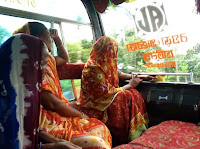
Believe me, I understand what they're feeling.  In some Bangladesh buses, the front seats are saved for women.  A few weeks ago, I sat in the back of a bus for the first time and was groped by a man; actually, a man who worked for the bus.  I smacked him hard on the head but that, of course, changes nothing.  I argue to sit in the front of the bus from now on to avoid harassment...

But I question:  is creating separate space harmful or helpful when you are trying to integrate the sexes into the same space?  The title is misleading, saying that there is "new peace" -- but the article goes on to discuss how men are harassing the women more, even defecating on the ladies' train to show disapproval.  Men are not happy - why?  Because their power is being taken away, of course.  Now not only can women get jobs, but now they are encouraged because they can feel comfortable commuting on these new trains.

Until recently, I've played devil's advocate by supporting the hijab, the Muslim head scarf.  I frequently recite something a female friend from Malaysia told me:

"When I was of age, my parents started making me wear the hijab.  I hated it, oh it was the worst.   I used to go to the mall with my friends after school and we'd rip off our hijabs and let our hair flow free.  But as I got older, I started to understand what it meant.  It wasn't to cover me up, but to protect me.  There are a lot of bad people out there, and they know that I am a woman of Allah.  It's like Christians wearing a cross around their neck to show their beliefs..."

I'd share this in my Women and Gender Studies classes, saying that after living in India, sometimes I just wanted to cover up too, hide my body so I won't be harassed.  It is common to say that women should cover up in order not to tempt men into committing sinful deeds, like harassment or rape.  My female friend in Malaysia said that they feel more protected from the eyes of dirty men in their hijab.  Outside of religious context, I compare the 'ladies only' trains to the wearing of the hijab for the purpose of protecting women from wandering eyes and hands.

But is hiding and protecting going to change the attitude that it is alright for men to inappropriately touch women?  Is wearing a hijab going to stop a man from realizing you have breasts that he could grope?  Is keeping all the women at the front of the bus or in separate cars suddenly disintegrate their immoral desires?  Instead of separating women, shouldn't they be teaching men to withhold and destroy these desires?  When did hiding or running away from the problem actually solve it?

What needs to happen is an attitude change: a change in the male perspective from aggression to acceptance and understanding of the positive effects of women empowerment.  I've read articles of both Western and local women and men giving lectures about positive aspects of women's empowerment to men.  I've read signs placed in public spaces by the government and NGOs declaring the value of women's housework.  But how often is our life changed by reading a sign during traffic?

One major problem I believe is implementation via the police.  The NYT article states that violence against women as increased: "Between 2003 and 2007, rape cases rose by more than 30 percent, kidnapping or abduction cases rose by more than 50 percent, while torture and molestation also jumped sharply."  A story is told about a woman who was beat by her husband for having a Western haircut.  What happened to the husband?  Did he do what is commonly done and pay off the police and got off scot-free?

The government is in favor of women's rights and empowerment, clearly stated in their order to universities to allow women to wear jeans, though the universities consider it 'indecent.'  The government funded the 'ladies only' trains in an effort to allow women to take outside jobs.  But, how often does the government force implementation on the rights violations of women?  How often are men imprisoned for rape and assault against women?  The violent acts are increasing, is imprisonment increasing at the same rate?

If Indian women, and the government they vote for* are making the decision to step outside the home and break down traditional patriarchal structures, hiding in private cars and under loose clothes will not change inherent animosity from those who take stock in patriarchy.  The women and it's government must be prepared to fight and show that this isn't temporary.  They must not stand silently during harassment, and the government should prove that it will not stand for the increased violence that occurs.  They must prove that this change is not temporary.


*India is the world's largest democracy.
And thanks, Courtney Parks, for sending me this article!