Showing posts with label Fulbright research. Show all posts

Thursday, July 22

Holes Carved in my Soul: The Final Word

I am almost back in the United States. What a year it has been. To begin to describe the Fulbright journey is to begin a novel of my personal and professional growth. As I sit here in the Edinburgh airport waiting for my flight to New York, I leave Bangladesh free as bird. Not that Bangladesh ever caged me. It was my frightened, insecure ego that kept me confined. But Fulbright and Bangladesh gave enough space to spread my wings and discover a world of endless possibilities--a world available to me if I climbed out of that shell and believed.

My heart still aches for Bangladesh: for the work that finally came together, for the friends who stole my heart, for the passion of such a congested place. I passed through Kolkata on my home, stepping into memories where the paagli didi journey began--I know I'll be back in Bangladesh at some point. My first visit to India effected me enough that I went back. Then when Bengal touched my heart, I came back again. I've proven that when I care about a place, I manage to find a way back.

So here is the end of my Fulbright experience in Bangladesh. I recommend Fulbright (or any similar scholarship) to any young person wanting a challenge. It has been the most rewarding experience in my life (though young, I've had plenty of amazing experiences). As for Bangladesh: when people ask the trite question, "What is Bangladesh like?" My answer is always "intense and beautiful." South Asia is just raw and real, that's what's beautiful. To paraphrase a metaphor by poet Andrea Gibson, Bangladesh is a knife that carves holes in your soul so beauty can make its way inside.

Endless thanks to those who were a part of this odyssey, both in Bangladesh and abroad. The shape of the journey depends on the company, and your company enveloped me in love. So love is all I experienced.

If anyone is interested in learning more about women's empowerment, Bangladesh or the Fulbright scholarship, please email me at amanda dot ferrandino (at) gmail dot com.

Sunday, May 23

Notes on being a Paagli Didi

It was a joke—this nickname. When studying and volunteering in Kolkata, I slowly picked up words in Bangla. Forever the entertainer, I was always trying to find words to bring comedy to the young women at the shelter where I volunteered. I learned that the word paagul meant ‘mad/crazy.’ One day at work, I called one of the girls paagul in jest. Everyone snickered as they said that paagli was the feminine of paagul. “Uhh…well then, tumi paagli!” Squealing at my new Bangla, they aptly rebutted with, ‘na—tumi paagli’ (no—you’re crazy!). After I said that we all are crazy, I became the leader, the didi—the big sister.

Working in that shelter inspired me enough to work on women’s empowerment as a career goal—and enough to tattoo this nickname on my wrist. The blue, soulful ink was aimed to be a reminder of my role as being the big sister to all I can: to help those in need, contribute positively to the world, love and support everyone in their challenges...even if I’m slightly silly and fun with it.

Trust me when I say that I forget more often than remember this to be my role. Especially in Bangladesh, various trials push me in a negative worldview causing selfish actions where I lose sight of being patient, charming and supportive. I’m still grappling with leaving school (one year graduation anniversary!) and facing the world on my own for the first time. I’m still forming opinions on all that surrounds me, tossing with truths and lies. And Lord, I chose to do it in a place outside all realms of normalcy!

So in this Fulbright experience, I wish I could have given more sisterly insanity. But the truth is that every didi has to take care of herself too. Often I found my spark submerged in the pollution of Dhaka, unable to find my heart’s compassion to be a paagli didi. There were a myriad of factors drowning me in self-pity and misdirected anger. While I came back to Bengal with the lofty expectations to deeply investigate women’s empowerment, it turned to be an extended (maybe endless) lesson of my personal and essential role in the world. I answered questions of who I am and who I want to be: what I love, what makes me feel good, what am I good at, what do I suck at, what can I improve, what can I accept?

I recognize the journey of self-discovery is crucial but a part of me wishes I could have incorporated my work more, helped a little more. But in the end, I think it’s best that I took the time to review my personality and morals—for what I believe is how I will act. Opinions can change from year to year as we mature with experiences, but the core of who you are shouldn’t. We should be eternally digging through the socially conditioned layers towards the heart, avoiding hypocrisy and superficial aesthetics. Self-awareness and self-love is the first step to being a true paagli didi.

I have a very special woman in my life. Enchanting, cheerful and forever radiating warmth, she is the most self-sacrificing woman I know. No, excuse me, than most people will ever know. She can remedy any problem of all who come to her with her networks, perseverance, compassion and intelligence. But in all that selfless beauty, she is drowning in others’ (and her own) constant and high demands—so much so that she isn’t taking care of herself. I admire and envy the truth of her but I am constantly reminding her how no one will receive help when she’s run into the ground.

Seeing her like this validates the importance of taking time for yourself, your body/mind/spirit before you can effectively give. Giving all the time will eventually leave you with nothing. I now have compassion for myself that I’ve been selfish in this journey—it’s needed. And I will compensate for it in due time.

I’ve accomplished a lot professionally and academically here: I’ve made contacts with several innovative (and no-so innovative) empowerment organizations and witnessed a range of progressive programs. Meeting these women firsthand and interviewing them in their village will remain the most crucial lessons of my professional career. Already I am shipping home reports, notes and books on my topic for future reference along with over 60 business cards of relevant employees in Bangladesh. But most importantly, I am dragging home a stronger Amanda: one who battled her own ill-temper, loneliness, doubt, and hatred—who came out still believing in the paagli didi inside her.

I am leaving Bangladesh taking more than I gave. But this relationship is far from over. I’ll make it up to her.

Monday, May 17

Empowering for you and me

“Anthropology was the science that gave her the platform from which she surveyed , scolded and beamed at the world.” Jane Howard on Margaret Mead

That's how I always felt about anthropology. I felt connected to the art by being about to learn about the world as wholly as possible. Feeling that we need to understand this world before we can help it, development research was a great way to do so. I imagined myself working for a research institute or the research department of an NGO, personally interviewing the people we want to help and finding out how we can help them. That was the drive behind this scholarship: to learn about programs that try to empower women and ask the women themselves how they want to be empowered.

Doing this work is another story. I enjoy interviewing survivors of sexual violence, because I learn about where they come from, what kind of programs they seek for empowerment and what they're dreams are for the future. With this information, I was hoping to publish a paper discussing their needs so better programs can be created. But during all the interviews, I felt I left them just as vulnerable as they were before. I began to feel that I was taking something from them, their story, a piece of them, to use for some high language, post modern academic paper that they will never see nor understand. To add insult to injury, most people who makes decisions on empowerment programs would never consider my findings because they are too wrapped up in what donors want anyway.

Where's the empowerment.. for anyone? I feel I left them not changing anything, leaving them as powerless and as scared of their future as were before I came. I can give them love, of course that helps, I'll always believe that. But that's not a tool they can hold onto, that's a feeling that will fade once I leave. I may have touched some lives, but my work is not sustainable. And in all honesty, where's the empowerment for me? I have felt powerless this entire trip, lost in the colossal mess of Bangladesh's corruption and violence. There were times I lost interest in my work completely because what was the point?

But this weekend, for the first time in the last 10 months, I finally felt I did something right.

My roommate Saba has self-defense training that she attended in India. Looking at the materials, I fell in love: physical and mental self-defense techniques and positive confidence building in a 2-3 day workshop with a group of women only. I begged Saba over a month to let me do a few workshops with her before I leave. While we're still in the process of planning with a few NGOs and universities, we held one 2-day workshop in our living room this past weekend with 8 of our girlfriends.

I never was so happy this entire trip. Combining my own personality traits with my knowledge on sexual assault, I was able to teach other women (our friends) why we face such tragedies as women in patriarchal societies. With Saba's help, we trained our friends how to escape from an attacker by hitting the the most vulnerable parts on a human body. We talked with them about how to define and assert their boundaries. We shared tips in positive personal decision-making and how women overcome the sexist barriers in front of them. It was only two days, it was just our friends (which, most of them are already quite aware of gender violence and are already pro-feminist).. but I felt so f-in good! What I loved was that personal feeling of empowerment being able to empower others. We ended the workshop not knowing how much they will remember, but at least we put these techniques out there and created a safe space for women to share all the awful experiences they keep to themselves. I really loved being a trainer.

So this is my career path: become a trainer on women's empowerment. Who knows where that exactly will lead, training companies on sexual harassment to sex education to confidence building techniques for young girls. I've found several promising organizations in the new city I'm moving to in September. Finally, I'm excited about my future, my empowering future, again.

Wednesday, April 21

"Isn't that rape?"

I'm livid. Personally livid.

As a researcher who studies gender issues and sexual violence in developing countries, I come to hear of some horrifying and disgusting things. But truth be told, I've been getting better at numbing myself to it. It's easier to push into the back of my brain and focus on my work. A lot of stories don't even shock me anymore (like when I came to find that brothels here stick freshly boiled eggs up sex worker's vagina's to punish them). Don't get me wrong, I'm still overwhelmingly angered that gender violence and discrimination is STILL occurring in the goddamn 21st century--but nothing surprises me anymore. Also, most of the time I'm talking to women who escaped and are now with an NGO, (hopefully) out danger. Maybe distancing myself is the only way I can continue with my work.

But it's a whole new set of emotions burst through that wall when something happens to someone you know.

I was supposed to hang out with my good friend yesterday but she cancelled. When I asked her why, she said that her family suddenly informed her that they have a marriage proposal for their 17 year-old daughter (my friend's niece). My friend has been paying her niece's school fees because her brother and his wife aren't working but are living on her family's land. I started to freak out, I thought she wanted to go to college. "I'm going there to meet him and ask her what she wants," my friend responded. I knew I regretted asking: "How old is he?" "35." You do the math.

I spoke to my friend today: "Well, my niece is getting married today." Restraining my fit of rage I ask her, "What did she say?"

"Well she said, 'Why not?' Amanda, she isn't allowed to leave the house now. My brother keeps her inside. She isn't allowed to go out and talk with her friends. She thinks that maybe when she married, her parents can't say anything and she'll have more freedom. She is miserable now, might as well try something new."

I sighed, "I still don't understand why a 35 year-old wants to marry a child."

"For the sex, Amanda. What else?"

"Isn't that rape?"

"Not here."

I know the gender imbalance of her country upsets her, but she just brushes it off as normal. I just can't accept it: because no woman wants that as a normal life, wants marriage as her only choice of escaping tyrant parents. 'Choice'--a word she doesn't know.

I've met this niece at a family gathering, she's sweet. It's just too close to home. It's repulsive and a violation of who we are as humans.

Thursday, April 15

Tangail's Brothel and Sex Work: The "At Least" Sydrome

Black and red smeared eyes peered out between the curtains of their rooms. Some women’s faces were painted white as a Geisha, dressed in vibrant, sparkly skirts. We didn’t know if their make-up was to appear more enticing to customers, or to disguise who they are under a mask.

Despite all the color and glamour, this was a dark place.

Diya and I took a trip through Bangladesh’s oldest brothel in Tangail. Walking through the small alleys, it was similar to a dirty, slum. The ground is the wastebasket and everything reeks of various human fluids. Houses (single room shacks) are practically on top of one another, sharing walls as apartment buildings. There’s no privacy with curtains for doors and outdoor bathrooms. The narrow alleys are filled with sex workers waiting for clients—and clients just dawdling, chatting with shopkeepers selling soda and chips, watching with televisions. It’s own self-sustaining community with food, shelter and water pumps. People could stay inside for weeks without needing to go outside the brothel. Diya turned to me at one point: “This is the strangest place I’ve ever been.”

It was only so uncomfortable knowing what goes on behind these billowing curtains. Shirtless men peered out from the beds, staring at us foreigners unashamed. Honestly, I couldn’t even look at the men. To the women, I tried to smile but I felt intrusive walking in on their work and home space. I didn't take photos for that reasons. And it was mid-day.

It was additionally heartbreaking after hearing the personal stories of the women. I don’t want to sensationalize their lives in this blog, but I do want to create awareness. Some women cried to us during their interviews, sharing how their parents abandoned them or they were sold into the brothel. One woman was so small, ten years old, that she wasn’t even menstruating when she was forced to have sex. Her body was so young and fragile her hip broke when one man was penetrating her. Some girls look (and are) so young that some madams (women pimps) inject hormones used to fatten cows. (Thanks for the link, Neelofer!)

Often, young girls and women are chukri, bonded prostitutes. A relative or the trafficker have a large debt that is endowed to the young woman. They work under a madam until it is paid. With extremely high and unfair interest, women have no other livelihood or skill by the time the debt is settled. Some continue with sex work or become madam, continuing the cycle. Often times, they make more money selling sex than any other job, but the cost of living in this brothel is much higher than living outside of it. Their earnings rarely stay in their hands.

We learned that most of the violence doesn’t come from customers, but from police and shopkeepers. Sex workers are constantly chastised and beaten when they step outside the brothel. Clearly these men don’t think that it’s their brother or neighbor who is buying sex services, perpetuating the demand for female sex workers.

The organization we went with gives trainings to the women on how to not appear like a prostitute outside the brothel. Their explanation was: “Sex workers are treated as their work all the time. A businessman can leave his business and be a father or brother. Sex workers are beaten when they aren’t working because people can tell what their work is by the way they walk and dress. We give them training on how look more respectable in the public eye.”

At first, I was disappointed by this training’s approach. The problem lies in the idea that men think that women’s bodies are dangerous and must be hidden. Telling sex workers to change their appearance is reiterating that sex work is immoral and should be kept out of the public view. But violence is occurring—what can be done to stop it now? By helping these women change their dress, they can at least be safe on the street.

“At least”—that term was ringing in our heads throughout the entire trip. So much violence is happening: physical, emotional, structural. There’s no way to change every thing at once. With small steps, though not perfect, women “at least” are moving forward on the long road to equality and empowerment. “At least” it’s better, not perfect, but better.

We witnessed the NGO workers holding hands and gossiping with some sex workers as if they are normal women (because, shocker, they are normal women). The staff was really sweet and non-judgmental. Diya asked the women about the organization’s work and it’s impact on the brothel community. Women responded that it was truly helpful. They are helping release bonded prostitutes from their debts and instructing condom use. The organization has this really innovative approach to providing services to women who are traumatized: a workbook that uses symbols for women to draw their experiences and express their needs (see left).

One woman responded that if the organization wasn’t there supporting the sex workers, some company would have torn down the brothel and built a factory. Without this community and space, sex work would be much more difficult, and dangerous.

I still toss around my opinion on legalizing sex work. One of the world’s oldest professions, it’s not disappearing. It’s impossible, and unsafe, to try to erase it. People will find a way so we should 'at least' protect them. But legalization does not suddenly transform how most sex workers don’t necessarily have much of a choice in picking that profession; nor does it erase the bullshit patriarchal notions behind sex work: that a man has such ‘unruly’ hormones that he can’t control his sex drive and need to use a woman’s body to fulfill this uncontrollable desire. Therefore, she is turned into a slut, something worthless. I will accept it’s legalization with maybe the following conditions: sex work is consented by the worker and client together, there are scholarships and services for workers who want to leave the profession, psycho-social therapy services as well as amazing health care (like athletes), anti-discrimination laws... and there are just as many male sex workers as female with just as many females clients as male. And let’s forget heteronormative sex. It’s confining and boring.

UPDATE: Thought-provoking article on laws against sex work in the UK.

Monday, March 15

Jessore: Liberal Rural Life

We were both excited and dreading to make the trip out to Jessore. The Lonely Planet wrote that there's nothing interesting about the town except hotels and restaurants. From other people, an image was painted about this border town of being, quite frankly, a shithole. But, being a border town, Jessore has an array of anti-trafficking NGOs so Diya and I made a trip.

But did we eat our words! Jessore was a wonderful little town: quiet, clean, driving with battery operated scooters. People were endlessly polite and not intrusive towards us two foreigners. Friends of friends took us to their village where we spent a day with a beautiful, warm family: a father who coaches the girl's cricket team, a mother who loves her straight-talkin' daughter-in-law, and a son who worships his girl child. And the town was filled with interesting, progressive and thorough NGOs.

We were both surprised at the progressiveness of a place that is dyed at rural, ignorant, traditional--and unswayed. However, after interviewing a few NGOs, looking at their groups and services, and attending a probing round-table discussion, we felt that this little town was doing substantial work, even more progressive than many of the programs we've seen in Dhaka.

For example, we met with an organization that is supporting over one-hundred women's empowerment groups in the state of Khulna. The org gives training, information and confidence building to men and women to go into their communities and establish groups that fight for community rights including women's rights. Through these trainings, they learn how to seek justice for domestic abuse. We met one beautiful, humble woman, Iti, who quoted a member of her community saying, "If you hit me again, I'm going to set Iti on you!" She has almost singlehandedly supported the women in her community from the training she received.

I've been thinking a lot about the important of rights trainings, confidence/empowerment groups and space. What I view as a huge problem of Bangladesh is it's limited space, not in the sense of it's crowded population, but it's expression. For surviving through a hectic day, whether a poor rickshaw-wallah, a troubled student, or a homesick ex-pat, there isn't much space to release all the pent up energy and anger. Part of has to do with the inability to pay to use space, but there aren't many free or cheap public or private spaces to let go: no bars, arcades, parks.. safe spaces to express yourself. That negative energy stays inside, builds up and is released in destructive ways, like domestic or child abuse. Man have more options with street-side tea stands to shoot the wind and relax, but women don't have those options.

Women's groups seem a vital way to permeate human rights into culture and society. It's not that women don't seek empowerment, it's that they don't have a space to even discuss it let alone take action on it. Groups as these give a space that is 1) safe, and supportive to share their frustrations and experiences of living as the second gender, 2) creative resource to fight for their rights and develop ways to create change and 3) encourage confidence that they are not wrong or alone and to stand with conviction.

One interesting note from the trip was the presence of technology. Mobile phones are as common as ever. Hotlines for human rights and legal justice are ever present and many groups mentioned how they can communicate to find information (ie. safe migration for example instead of trafficking). But with mobile phones, traffickers can also communicate to each other in forcibly sending people across the border. Now, as in the West, information is easily accessible--what skill in now needed is how to critically judge what is good information and what is bad.

Also, it was mentioned that there are a lot of extreme religious schools established in the area than ever before. Wahhabi Islamic money is flowing into the country from Saudi Arabia funding extremist schools. Slowly, this subversive ideology is penetrating Bangladesh's religious morals and I'm afraid of how it will rear it's ugly head in days to come.


Note of thanks to my Fulbright colleague, Diya Bose, and her endless patience, understanding, energy and intelligence, of whom I view more as a fabulous mentor than research partner.

Friday, February 12

The 'Living' Problem of Achieving Empowerment

Research Update: I don't write much about my actually research because I'm still processing what I'm learning at different development organizations, shelters and centers. Women's empowerment is a deeply rooted quandary--a complicated and living topic. 'Living' not only because it deals with real lives but because there is no one, consistent answer or path to empowerment: it's constantly shifting and changing as the world does.

My Fulbright colleague, Diya, is working on an almost identical topic about rehabilitation centers and their roles in creating empowerment. Last week, we (along with my visiting friend, Jika) went to the town Rajshahi to visit a community development center that has a few interesting programs on women's empowerment. The picture to the side is the three of us crammed in a rickshaw. We are still looking into the projects and I cannot divulge an analysis now (you'll have to wait for the published paper!)

But something that keeps coming up in our endless, circled conversations is how grey the solutions are. Our ceaselessly critical minds are never fully satisfied with any program we encounter. We've come--or are beginning--to understand that while there is no perfect answer, the best solutions are individual based, not system-based.

Organizations that are devoting their programs previously practiced method of empowerment don't leave room for the individuality of women's lives, decisions and cases. For example, often organization's play off the "typical" story of a trafficking victim (which, there is endless debate over using the word victim or survivor--an entry on constructed identity will come). The typical story being she was sold to a man who brought her to a brothel and was raped for 3 years until she escaped. Though that story does happen, there are millions of other stories that you don't hear.

At the center we visited, we heard a story of girl who was caught at border and man with her, presumed to be trafficker, was detained. The community center discovered after one year of working with the girl, the man was her adopted father. They begged together on the street and he took care of her. She wanted to cross the border to find a better job. When she was crossing, this man followed her to make sure she made it through okay. The man is legally blind and has no other family, just wanting to protect the only daughter he felt he had. "It's tragic," Diya said.

This is one case; one fish in an ocean. But that's the reality of trafficking: there is so much grey and individuality of cases that there can't be one solution. In all truth, there is not one 'evil man' and one 'victim,' instead various levels of informed consent exist. The man may not know the girl was trafficked or she might have chosen to migrate. But, the law doesn't work like this: there is moral and immoral, right and wrong, legal and illegal. If the law acknowledges that she consented to at least part of her 'trafficking,'* then she should be en-prisoned for illegally crossing the border, even though she was informed that the trafficker would cheat her. If you don't acknowledge her active consent, you see her as only a victim of unfortunate circumstance, not a woman trying to find a better life.

There is a line: where us as social beings are cornered by our cultural positions and responsibilities--and where we are active agents. Empowerment, as well as the path leading to it including justice systems, should be acknowledging and coaching our individual agency. This means looking at problems not in right or wrong verdicts, but for best options.

This woman to the right is a member of a women's empowerment group in a indigenous village outside of Rajshahi. Hearing the women shares stories about how they have changed their village from creating private ladies toilets, to having their sons and daughters attend school, to banning bootleg alcohol vendors, they were beaming and speaking with confidence and pride. Together, they worked on what they felt needed to be fixed in the village--and did it! Their empowered action worked for them and their tribe.

What they did might not work for everyone. Their needs were different from a neighboring village. But the confidence and power they gained is universal and everlasting--and with these skills they can continue to adapt to new problems and create new solutions. That's empowerment: never perfect, only ideal, by having ability to produce new ideas.

*Some women and men ask/want/need to migrate for jobs and need someone to help them cross the border. Depending, again, on the case, this can constitute trafficking or not; but it's not always clear because the victim may not be informed fully of their awaiting job or contract. So is it trafficking if he/she agreed to migrate but didn't know to where? Those questions and ambiguous answers create the grey.

Saturday, January 30

The First Interview

She's always cracking a joke. Most of them are dirty jokes, but she always has everyone around her laughing at her bold antics. Now, Mekti is ready for the interview, sitting strong, twisting the tip of her moss green kameez. Her hair is in two short braids with big white ribbons hanging down her back as she leans forward. With her earrings dancing to the steady tone of her voice. She continues looking down at her hands as she shares her story...

Mektis' father had two wives and abandoned her and her mother for the other wife. With no livelihood, she came to Dhaka with her uncle. They lived together but he went abroad to Malaysia then her mother came. Near her house, there was a boy that she loved. They wanted to be married but her mother didn’t agree with it. Eventually, when she was 13, they did get married. Soon, her mother told her: "If you’re married now, then your husband can take care of you." Being kicked out of her house, the new couple rented a new house in the slums of Dhaka. Her husband wasn’t working and Mekti kept pressuring him to get a job. Finally, he thought the best thing was to pull a rickshaw to make some money. When he went to a rickshaw owner to rent, the owner asked that his wife come to also give her word that he would pay rent on this rickshaw. When Mekti went to verify the contract, the owner thought she was very pretty. The owner arranged for another man to steal Mekti’s husband’s rickshaw. Because he hadn’t been working, the couple, both accountable, did not have enough money to pay off their new debt to the rickshaw owner. The owner then bartered: “If you can’t give money for the stolen rickshaw, then you can give your wife’s body as payment?” Her husband made a decision. They had no food, and were now in debt. In the interview, Mekti said, “What could he do?”

For the first few days, the rickshaw owner came alone to her house to use her body for his sick sexual pleasure. Soon after, he began to bring other men with him, two or three people at a time, “torturing” her. It was an extreme struggle and pressure for her having men come in and out of her home, abusing her entire self: mind, body and spirit. “I was young,” she said, now at the age of 18. “I felt death upon me when they came.”

She tried to stand up, not agreeing to perform this role. Her husband began to beat her, and tell the neighbors a false story to justify the bruises. By watching the money the rickshaw owner was making off of the additional men her brought to exploit his wife, Mekti’s husband became interested in selling her himself. He began doing business by her, now making money that was fully spent on heroin.

Eventually, Mekti’s mother heard about what was happening to Mekti, offering to take her back home and marry her off to a better man. Mekti at first refused, feeling that he would gain some sense soon. After more days and weeks of men coming to her home, abusing her, then watching her husband spend all the money on drugs, Mekti saw that he was getting more money this way and would not let up.

For some time, her husband left Dhaka so Mekti stayed in her mother’s home for four months. Upon her husband’s arrival back to Dhaka, he refused the divorce that Mekti and her mother were demanding, even offering to pay for the whole annulment. Finally, he gave in and Mekti received her divorce from the District Office for 2000tk.

Living with her mother after the whole incident, neither Mekti or her mother knew what to do next. With no education and a complete loss of self, she was 16 with no life options. Finally, her mother contacted a staff worker at the centre, wondering what she could do. Going to the office, Mekti told her story and they agreed to help her. She began taking vocational classes, learning how to sew. While she was working, another man, Dulal, took an interest in her. A hotel worker, Dulal agreed to marry her as long as she didn’t do work outside again. In the interview, she grinned and took a picture of him out of her wallet to flaunt. Her husband is very careful and she needs to ask permission to go anywhere out of protection. He knows everything about her life, from her past to her every day activities. Because he is from Syllet, after her training is finished, they will move back there. She said that this office gave her life light and feels that she will live a good life from here on out.

Please read soon on my first analysis of her life.

Sunday, January 17

STUCK Part II: Drowning in boiling water

Work at the training center is going well. My girls are used to me sitting with them, watching over their shoulder, taking notes. There hasn’t been any emergencies since Shona’s accident, gratefully, so days go by with ease.

Shona hasn’t been in to the center since her accident, and didn’t attend her certificate ceremony. Tuesday morning, I ask the girls how she is doing.

“Oh, Shona is better, but her daughter is hurt—a pot of boiling rice water fell on her.”

Minutes later, I’m back on a rickshaw with one other girl and a staff worker, heading to Shona’s house. Driving through the morning fog, we are back at the same slum. I feel less jerks bouncing around the roughly paved roads, going with the flow of the devastating surroundings. As we climb through the entrance of the cluster of homes where she lives, the curious crowd of 20 people follows.

Shona begins to cry as we enter the small one-room, dirt floor hut that she calls a home. Sitting on her bed with her feet flat under her, her little daughter sits on her left hip, donned in a ski cap and wrapped in a shawl. The first and last time I met this beautiful, long-lashed baby girl, she looked at me and crawled into my lap as if we were old friends. Many children stare at me in wonder, and my auntie’s nephew cries every time he sees me. But this little one isn’t afraid or intensely curious of my eyes or skin, and just relaxes.

Now I see her, sitting on her mother who holds the baby’s right arm out and away from the shawl. Her neck is covered in round, tender bubbles where her skin boiled from the water, down her shoulder. On her arm is 6-inch burn, her skin yellow and shiny. Dried blood surrounds her wrist and elbow. Biting back my own tears, I wipe away Shona’s as her pressed her daughter’s head into her breast.

We chat with her a bit, looking at the medicines the doctor gave her and allow her to vent to us. With the door crowded, the staff worker shoos them away to give them some space and privacy (not a common habit in Bangladesh.) One little girl stayed, hanging around the door, inching closer over the visit until she was sitting on my knee.

I gave Shona a small Christmas gift, as I did with the rest of the girls, and she wore her new earrings right away. As I hugged her to leave, I slipped her some more taka. With neighbors still watching, I didn’t want to be obvious. And I couldn’t help but look to the skies and say, “She just healed herself, and now her daughter is in pain. All their money is being spent on medicines because of accidents. She can't work because she's taking care of her baby, and her husband's a deadbeat. How can this happen twice to the same family in one month?”

It was an easier visit than the first, I suppose the misery is becoming routine to me too. Bouncing back in the rickshaw, holding the other woman’s hand, I wondered if it was harmful or helpful to become numb to grief out of survival. I arrived at the center with no answer.

Friday, December 4

Supporting a Cause: The Case of Organ-Grinding Charities

I love Barbara Ehrenreich: "Slap On a Pink Ribbon and Call It a Day"

What I love about her article is discussing how easy it can be to get people to follow you on a cause. Non-profit marketing are like advertisements: just buy into what we're showing you. No one asks whether or not the Dove shampoo destroys forests in Indonesia for it's chemicals (which it does, by the way) because "their ads are for real women!" And no one is asking whether or not a charity organization is actually doing good, sustainable work, because "my aunt had breast cancer, I want to support the cause." Please, I encourage you to support your aunt's disease, but we need to be asking better questions, as Ehrenreich said. Our support is meaningless if the organization is not doing real good work.

I've been looking at a multitude of development organizations here in Bangladesh. Something similar that has been gnawing at me is how organizations 'pimp out' their constitutes. In order to get money from donors or gain support from the international community, charities or NGO/FBOs show off 'good cases.' In Dhaka, organizations touring the slums take foreigners with their digital cameras, photograph smiling slum kids, show them the shitholes they live in--and leave. It's all a performance, to shock the money out of you. Where does that money go, and how much actually reaches the ground? The worst is for victims of sexual violence: "Look at her--she was raped by her uncle then sold to a brothel in Bombay. But we saved her, sheltered her and now she has a sewing machine to start a business! Now donate us money to do this for the next girl..."

This woman is humiliated as you are now privy to her saddest secret, and was she ever asked if she wants to sew? To me, it seems as if they are treated as stage monkeys, paraded around on a street, dancing to the organ: a way to get your attention and make money.

I place some blame on donors, both corporate and individuals alike, who are fickle and impatient as hell. Change, especially on the grassroots level, takes years; therefore investments and donations should be promised for years. Most grants don't cover for more than 3 years. So, charities wind up develop program budgets based around what donors want to see and not always what the constitutes need.

Just because you have a pocket of money and are full of good intentions doesn't mean that real change will happen. Development work takes a strong critical eye, uninterrupted efforts and extensive knowledge in local culture. It takes good training. I am even seeing that my work for one year is not enough time.

Tuesday, November 10

A Start to My Project: My Talent As A Human

I haven’t written too much about my work because I don’t know where my field notes will end up so confidentiality must be practiced. I’ll share a smige:

Currently I am working with a center that provides skills training (with certificates) for women who are trying to leave prostitution. In an old part of the city, I spend a few mornings a week with about 20 young women who learn to sew and make crafts for a living. There is one shop here is Bangladesh that sells their work as well as one in Norway.

My goal is to learn about these women in all ways possible: their backgrounds, their stories, their dreams. How did they end up as prostitutes? Why did they come to this center? Is this center helping them the best they can? How do they feel working here? As my Bangla improves, I am being a good anthropologist and performing participant observation. As the women are getting to know and feel comfortable with me, I sit on the floor with them and help them do their crafts. My body is even learning to sit like them for long periods of time (feet flat, knees bent touching shoulders).

My project, like most of my life, is overambitious. It takes months to understand then break into the professional world of this country—proven after speaking with some British women who said it took one year to begin their project on anti-trafficking with a team of ten. I am alone fighting this fight and sometimes I can be my work enemy. So my final work will most likely drift a lot from what I aimed for, but I plan to absorb as much of my topic as possible in the meantime. Fulbright is an amazing opportunity in that I have this flexibility to explore everything I want.

So the women at this center is a great start to hopefully a solid project. But as we learn about each other, I am just enjoying their company and love. Today, I sat on the ground listening to the girls gossip around me, tearing the thick strings out of square piece of green cloth. It felt therapeutic—to work with my hands, creating something, surrounded by these beautiful women all struggling to better their lives. With my current knowledge of Bangla, I’m not good for much except a good laugh and taking photos. But it’s a start—because we can always offer affection. More often than not, it’s returned. My sisters here certainly give it back tenfold…

And it’s vital with this week being an emotional week as I think about this time last year, and a young, unfortunate death. Even more emotional when I think about all those who are affected, mainly my best friend. I urge you all to show affection to those you care about—no reason necessary other than you can.

Thursday, October 15

Women and Islam

As a woman living in an Islamic country as a researcher of women’s issues, the matter of religion frequently rears its unresolved head. After reading several articles by Muslims, feminists and Muslim feminists (ie: Anouar Majid, Iman Hashim, Margot Badran) as well as a recent biography of Muhammed’s life written by a woman (Eminent Lives: Muhammad by Karen Armstrong), I will try to share a little of what I’ve learned of women in Islam.

The first important point is interpretation. Even with a book like a Qur’an, which is to be followed verbatim, there still remains historical context and diverging interpretations among the community. Muslim friends explained that many people who consider themselves Muslims have never read the Qur’an, but only hear other people’s interpretations. With the intent of the speaker differing across the world, many messages of the Qur’an are distorted. A friend said, “we should read the Qur’an as individuals, and what we get out of it is how we should practice. And not read just once – but many times. I have read the Qur’an when I was 18 and one message stood out to me. Read again at 25, other messages stood out. When I was 40, I learned something entirely new.”

This notion of interpretation leads into how there were particular intentions of Islam that were lost in dominating cultural pulls. “The gender question should be reexamined, as the gender revolution was intended in Islam but never took off. It was aborted arguably for two reasons…[one being] the door of ijtihad [intellectual effort] closed and the gender revolution was thereby aborted. (Mazrui, 1993)" The end of the intellectual effort (ijtihad) referred to what my friend mentioned above: individual interpretation. But because many followers cannot speak or read Arabic for themselves, the message and intellectual interpretation was lost.

Also, Muhammad faced intense adversity when trying to spread his message. One message was the equality of men and women: “Whoever performs good deeds, whether male or female and is a believer, We shall surely make him live a good life and We will certainly reward them for the best of what they did” (Qur’an, 16:97). However, some of Muhammad’s followers began to turn on him when he began to profess equality of women – equality extending as far as allowing women to take arms to fight for Islam.* In chauvinist Arabia, enemies against Islam became to use this ‘weakness for women’ against Muhammad while even his closest followers were aggressively disappointed in his equality stance (Armstrong). Muhammad’s message of equality, even with his charismatic ways, could not beat the ties to local culture (Armstrong gives an excellent review of how local culture affective the development of Islam). Overall, full gender equality was destined for Islam, however, like the development of the whole religion, was trapped by pre-existing Arabic culture. This entrapment is why the Qur’an permits men to beat their wives, which Muhammad feared and abhorred.

Then if these interpretations are accurate, then why do we hear so much anti-women and anti-equality professions of Islam?

First, sexism, chauvinism and misogyny still exists – everywhere. Those who preach male superiority quoted in Islam are widely considered to not be Muslims by Muslims. Second, Western media bombards us with the worst of the worst. Replaying images of women dashing out of their houses after the liberation from under the Taliban seeps into our mind, molding us to view all Muslims as the Taliban. We receive little public and personal exposure to Islamic ideals outside of the media because of the small population living in the west. It’s important to make judgments about a group of people that many of us have barely had a conversation with. One comedian, Russell Peters, put it so eloquently: “The only Muslims we see on Western TV is like people of the Middle East seeing Rednecks as the only Westerners.”

It’s important to remember that there are deeper layers of colonialism and exoticism at work. The West, past and present, perpetuates negative images of Islam in order to maintain it’s own superiority (as if we are perfect.) Attempting to make us sympathize with ‘subjugated veiled women’ gives the support they need to sanction their ulterior motives of wars.

“Muslim women’s entrapment in a false debate may well have started…with the publication of Qasim Amin’s book Tahir Al-Mar’a (The liberation of women) in 1899. [He] used the pretext of the veil…to launch an assault on Islam, despite Victorians England’s own patriarchal attitude towards British women… ‘Amin’s book then marks the entry of the colonial narrative of women and Islam—in which the veil and the treatment of women epitomized Islamic inferiority—into mainstream Arabic discourse. The opposition it generated similarly marks the emergence of an Arabic narrative developed in resistance narrative, not in the inferiority of the culture and the need to cast aside its customs in favor of those of the West, but, on the contrary, the dignity and validity of all native customs coming under attack—customs relating to women—and the need to tenaciously affirm them as a means of resistance to Western domination. ‘(Lelia Ahmed)” – Anouar Majid

Simply put, when people are attacked for their traditions, they are on the defense, griping even more tightly and fervently to what they are chastised for. Key point, however, is that the attackers hypocritically, aggressively and imprecisely combat ancient traditions.

I was once talking to someone about Islam and how misunderstood it was. Making a what I thought to be an obvious remark, that “not all Muslims are terrorists,” their response was, “but it is odd that most terrorist groups are Islamic.” Sadly enough, you can’t help but agree with their point, however the answer is deeper than their identity as Muslims, but into experiences as the colonized.

Like mentioned above, Islamic practices are so often being attacked that certain groups respond by vigorously asserting the exact practices that they are reproached for. The West’s past and present roles as colonialists and so-called ‘global leaders’ is in part at fault for exploitation of culture, resources and labor. Even apolitical, non-academics such as Greg Mortenson, the author of Three Cups of Tea, explains that the more we keep pressuring people to change, the more they will tightly grip onto traditions. Mortenson prompts us to work with and teach the on-the-ground population of other countries, especially by fiercely supporting education instead of bombs (please review article discussing Islam and Mortenson’s potent approach)

Islam in itself is pluralistic and ever-changing, as is the role of women in both Islam and global society. Trust me in that I’ve only scanned a brief surface of the issue and am still learning myself. But what we should already know is that it’s important not to assume we understand everyone experience and beliefs because of one label. We are more individual than that.

I want to end with a rather cute quote by the Sufi poet Jalal al-Din Rumi:

“The Prophet said that women totally dominate men of intellect and possessors of hearts. But ignorant men dominate women, for they are shackled by an animal ferocity. They have no kindness, gentleness or love, since animality dominates their nature. Love and kindness are human attributes; anger and sensuality belong to the animals. She is the radiance of God, she is not your beloved. She is a creator - you could say that she is not created.”

* The concept of the jihad is complex and historically rooted. When I feel I’ve grasped the doctrine better, I will speak on it.

Wednesday, October 14

Spontaneity and Her Role

To put it politely, the professional world is handled ‘differently’ in Bangladesh. My meetings have been cancelled because someone forgot to tell me that they decided not to come to the office today – discovered after I made the 100tk and 45 minute trek to their office. Or how professionals are always out of the office doing fieldwork, with no voicemail box and emails that bounce back. Or moving offices and not updating the new address and number on their website for 5 months. Or continuously postponing a meeting – for 6 weeks.

Yesterday, I was supposed to attend a meeting on the other side of the city – 20 minutes and 1.5km in a traffic jam, I get a text saying it’s cancelled – again. Should I just head home, or head to this place with nothing to do? It’s very hard to wander aimlessly in this city without the fear of falling into a sewage system or accidently winding up in a slum with your $600 camera in tote.

I stayed in the CNG and called another Fulbright Scholar, Herb Propper, knowing that he was doing a lecture in the same area. Herb and his assistant Saba have been kindly helping me try to get in contact with appropriate organizations for my project. Again, they generously invited me along to their event – which I then discovered was a private psychodrama session. With permission of the group members and my oath of confidentiality, I was allowed to sit in on the session.

It was one of those days where good things fall apart to make room for better things. I was blown away by the effectiveness and energy of pyschodrama. I saw, and Herb, correct me if I’m wrong, that a large part of psychodrama surrounds the concept of roles – how a drama has the different character actors, director etc.; our psyche works the same. One group member began to feel confused, pressured and weak. These feelings bubbled during one experiment. With this group member, a full psychodrama was performed, playing different roles to dig up the truth of the feelings and how to address them.*

I was stunned: sitting in a chair in the corner observing yet fully absorbed. I couldn’t help but cry at the intensity of this group member’s feelings, relating them to my own. I have a blessed curse of being able to relate to any emotion and being moved to love the person expressing it.

Herb began the session with an important theory that I needed to hear as well: the theory of spontaneity. One part of the simple definition of spontaneity is when you have an old, familiar situation with a new response – when this occurs, you have acted spontaneously. I have been here for three months still searching for avenues to do my topic. For three months, I’ve been approaching this project the same way, and I way I am used to (expecting speed and results). Clearly, it’s not working. So now I must adjust, adapt and change – either my process, or my topic.

So today, with the help of Saba, I finally could call one organization I’ve been trying to reach. They told me that in order to work in their shelter, which still doesn’t fit the ideal description of my project, I must write a letter to ask permission to just have a meeting with head of the shelter to then ask for approval to simply visit, let alone study. After a month of trying to reach them, yet another step! I was ready to throw the phone off the roof when I heard this. All I want is to love these women, is that so difficult?

But – I must adapt. I am here with a goal and it will be met, just in ways I don’t expect.

*Due to absolute confidentiality, the exact events of the drama will not be revealed.

Thursday, September 17

Sexual Harassment: Is separate space helping to integrate the sexes?


The above article discusses how in India, there are now separate train cars for 'ladies only' to commute due to the sexual harassment that occurs from their male peers.

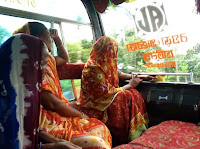
Believe me, I understand what they're feeling.  In some Bangladesh buses, the front seats are saved for women.  A few weeks ago, I sat in the back of a bus for the first time and was groped by a man; actually, a man who worked for the bus.  I smacked him hard on the head but that, of course, changes nothing.  I argue to sit in the front of the bus from now on to avoid harassment...

But I question:  is creating separate space harmful or helpful when you are trying to integrate the sexes into the same space?  The title is misleading, saying that there is "new peace" -- but the article goes on to discuss how men are harassing the women more, even defecating on the ladies' train to show disapproval.  Men are not happy - why?  Because their power is being taken away, of course.  Now not only can women get jobs, but now they are encouraged because they can feel comfortable commuting on these new trains.

Until recently, I've played devil's advocate by supporting the hijab, the Muslim head scarf.  I frequently recite something a female friend from Malaysia told me:

"When I was of age, my parents started making me wear the hijab.  I hated it, oh it was the worst.   I used to go to the mall with my friends after school and we'd rip off our hijabs and let our hair flow free.  But as I got older, I started to understand what it meant.  It wasn't to cover me up, but to protect me.  There are a lot of bad people out there, and they know that I am a woman of Allah.  It's like Christians wearing a cross around their neck to show their beliefs..."

I'd share this in my Women and Gender Studies classes, saying that after living in India, sometimes I just wanted to cover up too, hide my body so I won't be harassed.  It is common to say that women should cover up in order not to tempt men into committing sinful deeds, like harassment or rape.  My female friend in Malaysia said that they feel more protected from the eyes of dirty men in their hijab.  Outside of religious context, I compare the 'ladies only' trains to the wearing of the hijab for the purpose of protecting women from wandering eyes and hands.

But is hiding and protecting going to change the attitude that it is alright for men to inappropriately touch women?  Is wearing a hijab going to stop a man from realizing you have breasts that he could grope?  Is keeping all the women at the front of the bus or in separate cars suddenly disintegrate their immoral desires?  Instead of separating women, shouldn't they be teaching men to withhold and destroy these desires?  When did hiding or running away from the problem actually solve it?

What needs to happen is an attitude change: a change in the male perspective from aggression to acceptance and understanding of the positive effects of women empowerment.  I've read articles of both Western and local women and men giving lectures about positive aspects of women's empowerment to men.  I've read signs placed in public spaces by the government and NGOs declaring the value of women's housework.  But how often is our life changed by reading a sign during traffic?

One major problem I believe is implementation via the police.  The NYT article states that violence against women as increased: "Between 2003 and 2007, rape cases rose by more than 30 percent, kidnapping or abduction cases rose by more than 50 percent, while torture and molestation also jumped sharply."  A story is told about a woman who was beat by her husband for having a Western haircut.  What happened to the husband?  Did he do what is commonly done and pay off the police and got off scot-free?

The government is in favor of women's rights and empowerment, clearly stated in their order to universities to allow women to wear jeans, though the universities consider it 'indecent.'  The government funded the 'ladies only' trains in an effort to allow women to take outside jobs.  But, how often does the government force implementation on the rights violations of women?  How often are men imprisoned for rape and assault against women?  The violent acts are increasing, is imprisonment increasing at the same rate?

If Indian women, and the government they vote for* are making the decision to step outside the home and break down traditional patriarchal structures, hiding in private cars and under loose clothes will not change inherent animosity from those who take stock in patriarchy.  The women and it's government must be prepared to fight and show that this isn't temporary.  They must not stand silently during harassment, and the government should prove that it will not stand for the increased violence that occurs.  They must prove that this change is not temporary.


*India is the world's largest democracy.
And thanks, Courtney Parks, for sending me this article!

Saturday, September 12

Nari Khomotaeon

This entry is long overdue but I had difficulty deciding what to say.  The title of this entry in Bangla means “women empowerment.”  It’s a topic often forgotten, usually lost and sometimes thought unnecessary and discriminatory.  It is too deep a topic to dive into for one journal entry – but it is my life’s work.  It is still an issue in every country, including America – but for now I will focus on Bangladesh.

First, I want to share some statistics and stories of women’s reality here in Bangladesh:

- On the Gender Development Index, Bangladesh was ranked 120 out of 154 in 2007

-       BD is one of the top ranked countries that seclude and restrict its women (HRW)

-       The average age of marriage is younger 20 years, most likely not by choice but by parents, mainly father’s, choice ( )

-       50% of women have said they have experienced physical abuse by male partner.  In 2002, 68% of Bangladesh women never spoke to family or officials about their abuse (WHO, HRW, AI)  Only about 4,100 rapes are reported each year – this might be due to the silencing of women, as well as the fact that there is no law acknowledging marital rape. (WHO, UNIFEM)

-       Honor killings regularly occur, and 50% of all murders in Bangladesh are of women by their husbands (US Dept of Justice, HRW)

-       Because sons are still strongly preferred than daughters, 1.6 million girls are missing (missing means that by average, there would be more daughters in families if this discrimination didn’t exist.  Instead, they are missing, meaning killed, aborted, sold or not given proper medical attention or food.) (UN, US Census Bureau) 

-        85% of assembly line workers are women.  Factories demand unskilled labor at miniscule salaries – girls are less likely to have an education so they provide the unskilled labor for little pay.

-       More than 25% of young girls don’t finish their primary school education compared to the 10% of boys.   In universities, only about 35% of students are female.  And only 15% of primary school teachers are women. 59% of women are illiterate compared to men’s 46% (UNESCO)

-       Less than 5% of land owners are women due to widespread discrimination against women inheriting, owning or controlling property (ICRW)

Depressed enough?  Hold your hats, I haven’t even dove into the stats of trafficking yet.  But we’ll wait on that for another day.

In my two months here, I have met some amazing women.  When selling Iftar on the street, no exaggeration, 99% of the customers were men.  One women came to the table with a private car and beautiful purple sari.  Striking a conversation with her, she revealed to me that she had three jobs: professor of psychology at Dhaka University, private practice in psychology, and a writer for a children’s television program (the Bangla version of Sesame Street!).  I went to a lecture on Gender and Development at Dhaka University, the lecturer standing up there, confident and proud, arguing in favor of positive discrimination to a room full of men, with her daughter sitting on the side because no one was home to watch her.  Enormous strides have been made in women’s rights, including the passing of an act to reserve seats for women in Parliament, more women are attending school and working alongside their husbands.  Even one man proudly said, "Women can drive now!"

But, I have yet to see a woman driving here.  Laws are changing, but cultural practices are deeply embedded and are slow moving.  Empowerment is defined has the ability to make a choice, controlling life decisions and claiming rights.  By law, women are claiming more rights, but on the street and in the villages, too many social pressures exist that keep women inside, silenced and devalued.  Often, law enforcement official do not value or practice these laws.

But I will share one story that gave me hope:  at the lecture on Gender and Development, the woman lecturer was stating that positive discrimination was needed to raise women to the power level of men.  One example is on the crowded streets and buses that should reserve seats for women because men push women out of the way to get on the bus, and if she gets onto the bus, she is likely to be touched.  One man argued against this, saying, "Of course on a crowded bus you will be accidently bumped.  There's no need for special treatment."

Across the conference table, one of the 7 women in the room, wearing an hijab and quiet most of the night, leaned across the table and said, "I know the different between an accidental bump and a hand down my dress."

He shut up.

Women are speaking up.  Voice is the first step towards empowerment: vocalizing your situation, hearing stories to organize and create real change.  Just because Bangladesh has a woman Prime Minister, doesn't mean that governmental and structural changes reach the women who need it.  These cultural changes have to start with the women themselves.