
then this happens: Bangladesh Government Bans Facebook
Showing posts with label government. Show all posts
Showing posts with label government. Show all posts
Saturday, May 29
The Power of Government Destroys Youth's Little Freedom...
I re-joined the goddamn social networking site to keep in touch with Bangladeshi friends...

Tuesday, November 3
With Privilege Comes Responsibility: The Case of Corrupt Governments
I’ve been thinking about superheroes stories. In all the comics, movies and tales, when one is given extraordinary powers, they either execute them for good or evil. Obvious that those who choose to use their new power for evil do so to gain more power over those who are weaker—a pathetic and unsophisticated way to spend your time here on Earth. What interests me more is the urge of responsibility heroes like Superman and Spiderman felt with their power. Their superpowers are a privilege, an obvious advantage over the rest of the human population. With this privilege, they felt an overwhelming responsibility to protect and spread their privilege.
Note the word ‘superpower’ and think about today’s politics...
A story meriting little mention to the world was an assassination attempt here in Dhaka a couple of weeks ago. The attack was aimed at Fazle Noor Taposh, a lawmaker and nephew of the Prime Minister of the Awami League party Sheikh Hasina; only 13 people were reported to have been wounded.
I was told this the morning of my last day of Bangla class. My teacher Pulok revealed the story to Hiroto and I. Somehow I brought up the corruption of the Bangladesh government, listed to be the second most corrupt government in the world according to Nation Master. I began to argue that the Bangladeshi people kept the government corrupt by electing the same officials and politicians who don’t do much for citizens.
“How can we elect new politicians when you can’t become a politician without money?" said Pulok-Da. "The same people keep getting reelected because it’s the same people who have all the money.” It’s something I’ve noticed too; there is a very small middle class in Bangladesh, mostly living in Dhaka. And when they are poor – they are destitute. When they are rich – they. are. RICH! I’ve seen Escaldes almost flatten beggars on Mirpur Road.
Pulok-da went on to say that it is up to America to end corruption in government (and other Western governments, but we’ll use America as the example because the world DOES use us as an example: we are both the lock and the key to the worlds problems.) “It’s up to America to put pressure on our government to change her ways of corruption. America has already done that with Islamic fundamentalism—and it’s working! Believe me that there are less violent uprisings and radical groups than a few years back. A lot of it has to do with the money America gives to us to suppress these radical regimes, and the investigations to confirm the money is spent to end these violent ideologies. If America would only do the same for our corrupt government, maybe we would get somewhere.”
I stated that yes, external pressure from governments does have some effect (i.e. South Africa’s apartheid), but pressure has to come internally—from the people themselves. Pulok-da looked up and said, “With what rights? This is not a democracy, only a façade. I have no say. The police can arrest and frame me for anything. If Obama’s daughter committed a murder, she would be jailed, she is not protected just because she is a VIP. But here, if Sheik Hasina’s cousin did the same, he would be protected. Even with my job, I have to listen to everything my boss says. If he said to walk from my house to my work, a trip of over 4 hours, I would have to. I risk losing my job if I ever disobey and how will a find another? You must listen to your boss in the US but you have rights and you can argue and still keep your job. If you were unlawfully fired or hurt, you can seek retribution. We can’t argue here. No, we need you.”
America’s superpower is that of voice—the freedom and the protection of our voices. Let’s think clearly of how we are going to decide to use it. Unlike other superheroes who didn’t ask for their privilege, we created our superpower and with it our responsibility.
Life is always more complicated than a comic strip, but perhaps our principles can be more simplified...
Follow-up: Response to Nikolas Kristof's Op-Ed
Thursday, September 17
Sexual Harassment: Is separate space helping to integrate the sexes?
The above article discusses how in India, there are now separate train cars for 'ladies only' to commute due to the sexual harassment that occurs from their male peers.
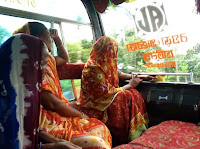
Believe me, I understand what they're feeling. In some Bangladesh buses, the front seats are saved for women. A few weeks ago, I sat in the back of a bus for the first time and was groped by a man; actually, a man who worked for the bus. I smacked him hard on the head but that, of course, changes nothing. I argue to sit in the front of the bus from now on to avoid harassment...
But I question: is creating separate space harmful or helpful when you are trying to integrate the sexes into the same space? The title is misleading, saying that there is "new peace" -- but the article goes on to discuss how men are harassing the women more, even defecating on the ladies' train to show disapproval. Men are not happy - why? Because their power is being taken away, of course. Now not only can women get jobs, but now they are encouraged because they can feel comfortable commuting on these new trains.
Until recently, I've played devil's advocate by supporting the hijab, the Muslim head scarf. I frequently recite something a female friend from Malaysia told me:
"When I was of age, my parents started making me wear the hijab. I hated it, oh it was the worst. I used to go to the mall with my friends after school and we'd rip off our hijabs and let our hair flow free. But as I got older, I started to understand what it meant. It wasn't to cover me up, but to protect me. There are a lot of bad people out there, and they know that I am a woman of Allah. It's like Christians wearing a cross around their neck to show their beliefs..."
I'd share this in my Women and Gender Studies classes, saying that after living in India, sometimes I just wanted to cover up too, hide my body so I won't be harassed. It is common to say that women should cover up in order not to tempt men into committing sinful deeds, like harassment or rape. My female friend in Malaysia said that they feel more protected from the eyes of dirty men in their hijab. Outside of religious context, I compare the 'ladies only' trains to the wearing of the hijab for the purpose of protecting women from wandering eyes and hands.
But is hiding and protecting going to change the attitude that it is alright for men to inappropriately touch women? Is wearing a hijab going to stop a man from realizing you have breasts that he could grope? Is keeping all the women at the front of the bus or in separate cars suddenly disintegrate their immoral desires? Instead of separating women, shouldn't they be teaching men to withhold and destroy these desires? When did hiding or running away from the problem actually solve it?

What needs to happen is an attitude change: a change in the male perspective from aggression to acceptance and understanding of the positive effects of women empowerment. I've read articles of both Western and local women and men giving lectures about positive aspects of women's empowerment to men. I've read signs placed in public spaces by the government and NGOs declaring the value of women's housework. But how often is our life changed by reading a sign during traffic?
One major problem I believe is implementation via the police. The NYT article states that violence against women as increased: "Between 2003 and 2007, rape cases rose by more than 30 percent, kidnapping or abduction cases rose by more than 50 percent, while torture and molestation also jumped sharply." A story is told about a woman who was beat by her husband for having a Western haircut. What happened to the husband? Did he do what is commonly done and pay off the police and got off scot-free?
The government is in favor of women's rights and empowerment, clearly stated in their order to universities to allow women to wear jeans, though the universities consider it 'indecent.' The government funded the 'ladies only' trains in an effort to allow women to take outside jobs. But, how often does the government force implementation on the rights violations of women? How often are men imprisoned for rape and assault against women? The violent acts are increasing, is imprisonment increasing at the same rate?
If Indian women, and the government they vote for* are making the decision to step outside the home and break down traditional patriarchal structures, hiding in private cars and under loose clothes will not change inherent animosity from those who take stock in patriarchy. The women and it's government must be prepared to fight and show that this isn't temporary. They must not stand silently during harassment, and the government should prove that it will not stand for the increased violence that occurs. They must prove that this change is not temporary.
*India is the world's largest democracy.
And thanks, Courtney Parks, for sending me this article!
Saturday, September 12
Nari Khomotaeon

This entry is long overdue but I had difficulty deciding what to say. The title of this entry in Bangla means “women empowerment.” It’s a topic often forgotten, usually lost and sometimes thought unnecessary and discriminatory. It is too deep a topic to dive into for one journal entry – but it is my life’s work. It is still an issue in every country, including America – but for now I will focus on Bangladesh.
- On the Gender Development Index, Bangladesh was ranked 120 out of 154 in 2007
- BD is one of the top ranked countries that seclude and restrict its women (HRW)
- The average age of marriage is younger 20 years, most likely not by choice but by parents, mainly father’s, choice ( )
- 50% of women have said they have experienced physical abuse by male partner. In 2002, 68% of Bangladesh women never spoke to family or officials about their abuse (WHO, HRW, AI) Only about 4,100 rapes are reported each year – this might be due to the silencing of women, as well as the fact that there is no law acknowledging marital rape. (WHO, UNIFEM)
- Honor killings regularly occur, and 50% of all murders in Bangladesh are of women by their husbands (US Dept of Justice, HRW)
- Because sons are still strongly preferred than daughters, 1.6 million girls are missing (missing means that by average, there would be more daughters in families if this discrimination didn’t exist. Instead, they are missing, meaning killed, aborted, sold or not given proper medical attention or food.) (UN, US Census Bureau)
- 85% of assembly line workers are women. Factories demand unskilled labor at miniscule salaries – girls are less likely to have an education so they provide the unskilled labor for little pay.
- More than 25% of young girls don’t finish their primary school education compared to the 10% of boys. In universities, only about 35% of students are female. And only 15% of primary school teachers are women. 59% of women are illiterate compared to men’s 46% (UNESCO)
- Less than 5% of land owners are women due to widespread discrimination against women inheriting, owning or controlling property (ICRW)
Depressed enough? Hold your hats, I haven’t even dove into the stats of trafficking yet. But we’ll wait on that for another day.
In my two months here, I have met some amazing women. When selling Iftar on the street, no exaggeration, 99% of the customers were men. One women came to the table with a private car and beautiful purple sari. Striking a conversation with her, she revealed to me that she had three jobs: professor of psychology at Dhaka University, private practice in psychology, and a writer for a children’s television program (the Bangla version of Sesame Street!). I went to a lecture on Gender and Development at Dhaka University, the lecturer standing up there, confident and proud, arguing in favor of positive discrimination to a room full of men, with her daughter sitting on the side because no one was home to watch her. Enormous strides have been made in women’s rights, including the passing of an act to reserve seats for women in Parliament, more women are attending school and working alongside their husbands. Even one man proudly said, "Women can drive now!"
But, I have yet to see a woman driving here. Laws are changing, but cultural practices are deeply embedded and are slow moving. Empowerment is defined has the ability to make a choice, controlling life decisions and claiming rights. By law, women are claiming more rights, but on the street and in the villages, too many social pressures exist that keep women inside, silenced and devalued. Often, law enforcement official do not value or practice these laws.
But I will share one story that gave me hope: at the lecture on Gender and Development, the woman lecturer was stating that positive discrimination was needed to raise women to the power level of men. One example is on the crowded streets and buses that should reserve seats for women because men push women out of the way to get on the bus, and if she gets onto the bus, she is likely to be touched. One man argued against this, saying, "Of course on a crowded bus you will be accidently bumped. There's no need for special treatment."
Across the conference table, one of the 7 women in the room, wearing an hijab and quiet most of the night, leaned across the table and said, "I know the different between an accidental bump and a hand down my dress."
He shut up.
Women are speaking up. Voice is the first step towards empowerment: vocalizing your situation, hearing stories to organize and create real change. Just because Bangladesh has a woman Prime Minister, doesn't mean that governmental and structural changes reach the women who need it. These cultural changes have to start with the women themselves.
Subscribe to:
Posts (Atom)


 Posts
Posts

