Monday, May 17
Empowering for you and me
Thursday, April 15
Tangail's Brothel and Sex Work: The "At Least" Sydrome
Black and red smeared eyes peered out between the curtains of their rooms. Some women’s faces were painted white as a Geisha, dressed in vibrant, sparkly skirts. We didn’t know if their make-up was to appear more enticing to customers, or to disguise who they are under a mask.
Despite all the color and glamour, this was a dark place.
It was only so uncomfortable knowing what goes on behind these billowing curtains. Shirtless men peered out from the beds, staring at us foreigners unashamed. Honestly, I couldn’t even look at the men. To the women, I tried to smile but I felt intrusive walking in on their work and home space. I didn't take photos for that reasons. And it was mid-day.
It was additionally heartbreaking after hearing the personal stories of the women. I don’t want to sensationalize their lives in this blog, but I do want to create awareness. Some women cried to us during their interviews, sharing how their parents abandoned them or they were sold into the brothel. One woman was so small, ten years old, that she wasn’t even menstruating when she was forced to have sex. Her body was so young and fragile her hip broke when one man was penetrating her. Some girls look (and are) so young that some madams (women pimps) inject hormones used to fatten cows. (Thanks for the link, Neelofer!)
Often, young girls and women are chukri, bonded prostitutes. A relative or the trafficker have a large debt that is endowed to the young woman. They work under a madam until it is paid. With extremely high and unfair interest, women have no other livelihood or skill by the time the debt is settled. Some continue with sex work or become madam, continuing the cycle. Often times, they make more money selling sex than any other job, but the cost of living in this brothel is much higher than living outside of it. Their earnings rarely stay in their hands.
We learned that most of the violence doesn’t come from customers, but from police and shopkeepers. Sex workers are constantly chastised and beaten when they step outside the brothel. Clearly these men don’t think that it’s their brother or neighbor who is buying sex services, perpetuating the demand for female sex workers.
The organization we went with gives trainings to the women on how to not appear like a prostitute outside the brothel. Their explanation was: “Sex workers are treated as their work all the time. A businessman can leave his business and be a father or brother. Sex workers are beaten when they aren’t working because people can tell what their work is by the way they walk and dress. We give them training on how look more respectable in the public eye.”
At first, I was disappointed by this training’s approach. The problem lies in the idea that men think that women’s bodies are dangerous and must be hidden. Telling sex workers to change their appearance is reiterating that sex work is immoral and should be kept out of the public view. But violence is occurring—what can be done to stop it now? By helping these women change their dress, they can at least be safe on the street.
“At least”—that term was ringing in our heads throughout the entire trip. So much violence is happening: physical, emotional, structural. There’s no way to change every thing at once. With small steps, though not perfect, women “at least” are moving forward on the long road to equality and empowerment. “At least” it’s better, not perfect, but better.

We witnessed the NGO workers holding hands and gossiping with some sex workers as if they are normal women (because, shocker, they are normal women). The staff was really sweet and non-judgmental. Diya asked the women about the organization’s work and it’s impact on the brothel community. Women responded that it was truly helpful. They are helping release bonded prostitutes from their debts and instructing condom use. The organization has this really innovative approach to providing services to women who are traumatized: a workbook that uses symbols for women to draw their experiences and express their needs (see left).
One woman responded that if the organization wasn’t there supporting the sex workers, some company would have torn down the brothel and built a factory. Without this community and space, sex work would be much more difficult, and dangerous.
I still toss around my opinion on legalizing sex work. One of the world’s oldest professions, it’s not disappearing. It’s impossible, and unsafe, to try to erase it. People will find a way so we should 'at least' protect them. But legalization does not suddenly transform how most sex workers don’t necessarily have much of a choice in picking that profession; nor does it erase the bullshit patriarchal notions behind sex work: that a man has such ‘unruly’ hormones that he can’t control his sex drive and need to use a woman’s body to fulfill this uncontrollable desire. Therefore, she is turned into a slut, something worthless. I will accept it’s legalization with maybe the following conditions: sex work is consented by the worker and client together, there are scholarships and services for workers who want to leave the profession, psycho-social therapy services as well as amazing health care (like athletes), anti-discrimination laws... and there are just as many male sex workers as female with just as many females clients as male. And let’s forget heteronormative sex. It’s confining and boring.
UPDATE: Thought-provoking article on laws against sex work in the UK.
Friday, April 2
Bangladesh Surf Club
Monday, March 15
Jessore: Liberal Rural Life
We were both excited and dreading to make the trip out to Jessore. The Lonely Planet wrote that there's nothing interesting about the town except hotels and restaurants. From other people, an image was painted about this border town of being, quite frankly, a shithole. But, being a border town, Jessore has an array of anti-trafficking NGOs so Diya and I made a trip.
Wednesday, January 13
Friday, December 4
Supporting a Cause: The Case of Organ-Grinding Charities
Wednesday, November 25
Tuesday, November 10
STUCK: between a rock and a hard place--or a car and a rickshaw..
I arrived at the center today to hear that Shona* was home sick. I imagined a cold or cramps. The story unfolds that a few days earlier she went to the market and was smashed in between a rickshaw and a CNG, penetrating her stomach.
With one other girl from the center Lila*, myself and three aid workers head to Shona’s house. Weaving through the cool morning on a rickshaw, one aid worker Rahim* shares Shona’s story. Her parents are not around and she is married to a man who “is not bad, but not good.” She was a sex worker for a few years when she had no other livelihood available. Finding the organization, she has been working for them doing crafts and making a steady income. Her husband doesn’t work and relies on Shona to support him and their two year-old daughter. The other aid workers gush about Shona, saying that she never argues with the other girls and always helps them when they need it. I see it in her: she is a complete doll. She and I have dance sessions to entertain everyone at the center. It’s uncommon for a Bangla woman to laugh as loud as she does, and I mirror it with my own.
It starts getting quiet as we get farther away from city’s business center and the sun stronger as the buildings shrink from 5 stories to at most 2 levels. The roads increasingly dirtier, bumpier, at parts non-existent or slanted from earthquakes. Getting off the rickshaw in an alley that can fit only three persons, Lila leads us through the garbage filled ditches rotting in the sun. A constant cloud of flies swarm around my feet as we step into a cluster of tin homes, each perhaps three times the size of my clothes closet on Long Island. Seeing aid workers and a bideshi (foreigner), adults and children start popping out of everywhere to follow us. Shona’s name is whispered amongst the indistinct Bangla around me when we enter her home.
She was lying on a bed lined with a plastic table cloth with one sheet covering her. The bed took up one third of the entire house (one room) with tin walls and ceiling. Her husband stood in the corner, watching us pile in with the curious entourage behind us. The rest of the room had one chair and shelves with clothes, pots and plastic bags with personal belongings.
Shona was moaning in pain, holding her stomach. Seeing us, she began to cry and grasped onto my arm, mumbling in Bangla. I covered her forehead with kisses. She lifted up her sheet and revealed the wound. I looked away, I couldn’t see it. Her daughter came around the corner with the biggest eyes and sweetest cheeks, happily placing herself in my lap as she watched her mother breath heavy. Bangla was thrown around the tiny hut too fast for me to understand. Just as I felt that I was going to hit someone if I wasn’t informed as to what was happening, Rahim finally explained: the doctor saw her for a few minutes, gave her 2-weeks worth of antibiotics cost 1000tk and Shona’s husband took out a loan of 500tk to pay for the visit but now have no money to pay for food. That’s about 20 dollars. I handled the money situation but I was so concerned about what she was feeling now. Ambulances don’t really exist, no car or even bicycle could make it to her slum door: so she must walk with this pain to the street, get on a rickshaw and bounce her way through the slum then through traffic to the hospital.
What else can we do, I keep pestering. A stretcher to the street and I'll get a taxi? Can we bring a doctor to her? I was met with nothing but blank stares. Nothing else could be done.
But that’s all I can do right now. I don’t know what else to do. Recalling the monring, it reads like any other humanitarian documentary covering a similar story. That’s what is so sad: there are so many stories like this: continuously and daily, too common that it’s cliché. But I cannot bellow loud enough or clearly enunciate how though it is prevalent, it is still continuously harrowing and crippling for them. Shona may not have experienced life outside of permanent devastation, but that doesn’t mean that she is ignorant that it should be better.
* Names have been changed.
A Start to My Project: My Talent As A Human
I haven’t written too much about my work because I don’t know where my field notes will end up so confidentiality must be practiced. I’ll share a smige:
Currently I am working with a center that provides skills training (with certificates) for women who are trying to leave prostitution. In an old part of the city, I spend a few mornings a week with about 20 young women who learn to sew and make crafts for a living. There is one shop here is Bangladesh that sells their work as well as one in Norway.
My goal is to learn about these women in all ways possible: their backgrounds, their stories, their dreams. How did they end up as prostitutes? Why did they come to this center? Is this center helping them the best they can? How do they feel working here? As my Bangla improves, I am being a good anthropologist and performing participant observation. As the women are getting to know and feel comfortable with me, I sit on the floor with them and help them do their crafts. My body is even learning to sit like them for long periods of time (feet flat, knees bent touching shoulders).
My project, like most of my life, is overambitious. It takes months to understand then break into the professional world of this country—proven after speaking with some British women who said it took one year to begin their project on anti-trafficking with a team of ten. I am alone fighting this fight and sometimes I can be my work enemy. So my final work will most likely drift a lot from what I aimed for, but I plan to absorb as much of my topic as possible in the meantime. Fulbright is an amazing opportunity in that I have this flexibility to explore everything I want.
So the women at this center is a great start to hopefully a solid project. But as we learn about each other, I am just enjoying their company and love. Today, I sat on the ground listening to the girls gossip around me, tearing the thick strings out of square piece of green cloth. It felt therapeutic—to work with my hands, creating something, surrounded by these beautiful women all struggling to better their lives. With my current knowledge of Bangla, I’m not good for much except a good laugh and taking photos. But it’s a start—because we can always offer affection. More often than not, it’s returned. My sisters here certainly give it back tenfold…
And it’s vital with this week being an emotional week as I think about this time last year, and a young, unfortunate death. Even more emotional when I think about all those who are affected, mainly my best friend. I urge you all to show affection to those you care about—no reason necessary other than you can.
Monday, November 9
South Asian Education and Development: Rooted in Histories
Now, I debate with myself over Nicholas Kristof and the sincerity and authenticity of this work. This article was one of disappointment.
I can agree with Kristof’s overall point: a message to the US government to stop bombing countries and start to develop them by providing schools. This is one of the best ways to bring recurring, deep change. He brought up Greg Mortenson, a humanitarian I have mentioned before who has pioneered building schools in Pakistan and Afghanistan with his bare hands (not an expression, actually true.) Kristof noted that these schools are secular and are not being threatened and are welcomed by the community. Rich Islamic extremists are building schools that teach solely radical Islam, which end up being the only outlet for poor families to give their children an education. If extremists are investing in the youth to spread a particular message, can’t we start to invest in schools to spread a more secular message?

Then Kristof compared Pakistan with Bangladesh. First off, not a good idea. The two nations may have been one 50 years back but that in no means allows for a comparison: the Pakistan of 1947-1971 was forced by the British, nations separated by their enemy, India, speaking separate languages with differing cultures and economies. These differences lead to the Liberation War making Bangladesh it's own country. Pakistan is to Bangladesh as the US is to Nicaragua. To this day I don’t know how India survives with it’s own diversity.
Kristof makes the comparison that Bangladesh focused on education since becoming it’s own nation in a way that Pakistan never did. But Bangladesh received more help than Pakistan. Bangladesh was the poster-child of a desperate nation so much so that George Harrison along with Ravi Shankar held a concert in New York in 1971 to send money through UNICEF. No one did that for Pakistan. Also, Bangladesh has become the ‘development capital of the world’—education not the only focus but providing medical, social and environmental services. Education will do nothing if the current surrounding society isn’t improved. Kristof then claimed that, “Bangladesh now has more girls in high school than boys.”
At first I wondered how accurate of a statistic this is (it was not referenced). Looking at UNICEF, it seems that Bangladesh is a forerunner in achieving equality of gender enrollment in schools. Enrollment is one thing; attendance and continuing education are another--25% of Bangladeshi girls don't actually finish their primary school education according to UNESCO 2007. Kristof then says that “those Bangladeshi women joined the labor force, laying the foundation for a garment industry…” Educated women do not go into the garment industry. This industry is one of mostly unskilled labor for the most part so much so that children can work there.

The next day, I mentioned the article to an amazing friend; his father is Burmese, and his mother Persian, they met in Chittagong, Bangladesh then moved to New Jersey. He speaks English, Bangla, Urdu and local Chittagong language. He agreed, and shared some of his insight by mentioning how Bangladesh is very homogeneous: everyone speaks the same language (though dialects) and it is a very small country where it is easy to travel (via river or over the land which is mostly flat). Also add into the fact that Bangladesh fought for their country: an instant camaraderie existed as all Bangladeshis fought behind Bangabadhu for their language and culture. It was their choice and their families and neighbors as one.
Pakistan, even Afghanistan, are quite heterogeneous where communication between tribes is difficult over endless hills, too much desert and a myriad of languages. Perhaps now Afghanistan and Pakistan are uniting in their own countries—but at the rate we’re going it’s going to be in hatred against us.
While I support Kristof’s, I urge him not to compare too much two different societies. Of course, use one as an example but take into account the different histories that lead to the differences that exist today.
Wednesday, October 14
Spontaneity and Her Role
To put it politely, the professional world is handled ‘differently’ in Bangladesh. My meetings have been cancelled because someone forgot to tell me that they decided not to come to the office today – discovered after I made the 100tk and 45 minute trek to their office. Or how professionals are always out of the office doing fieldwork, with no voicemail box and emails that bounce back. Or moving offices and not updating the new address and number on their website for 5 months. Or continuously postponing a meeting – for 6 weeks.
Yesterday, I was supposed to attend a meeting on the other side of the city – 20 minutes and 1.5km in a traffic jam, I get a text saying it’s cancelled – again. Should I just head home, or head to this place with nothing to do? It’s very hard to wander aimlessly in this city without the fear of falling into a sewage system or accidently winding up in a slum with your $600 camera in tote.
I stayed in the CNG and called another Fulbright Scholar, Herb Propper, knowing that he was doing a lecture in the same area. Herb and his assistant Saba have been kindly helping me try to get in contact with appropriate organizations for my project. Again, they generously invited me along to their event – which I then discovered was a private psychodrama session. With permission of the group members and my oath of confidentiality, I was allowed to sit in on the session.
It was one of those days where good things fall apart to make room for better things. I was blown away by the effectiveness and energy of pyschodrama. I saw, and Herb, correct me if I’m wrong, that a large part of psychodrama surrounds the concept of roles – how a drama has the different character actors, director etc.; our psyche works the same. One group member began to feel confused, pressured and weak. These feelings bubbled during one experiment. With this group member, a full psychodrama was performed, playing different roles to dig up the truth of the feelings and how to address them.*
I was stunned: sitting in a chair in the corner observing yet fully absorbed. I couldn’t help but cry at the intensity of this group member’s feelings, relating them to my own. I have a blessed curse of being able to relate to any emotion and being moved to love the person expressing it.
Thursday, September 17
Sexual Harassment: Is separate space helping to integrate the sexes?


Sunday, September 6
Development In(-)Action: North Bengal Part II
“They hung their heads in shame as their mother stood behind them, the end of their sari wrapped around their head and mouth, listening to their children’s grades read aloud to the entire village…”
Last Saturday my friend Maude was gracious enough to let me tag along to watch her work with her NGO. We hop on the back of her friend’s motorbike that takes us to the river. Maude turns to me and said, “Today we are going to a char to do interviews.” We climb onto this long wooden boat with a motor, bamboo roof and wicker mats to sit on.
“Oh, by the way, the trip is almost two hours.”
Staff from the NGO climb into the boat; one is able to speak English, Maude’s translator from the NGO. They all play card games or nap the whole trip, while Maude and I speak with the translator about Bengal politics and finance. At one point, the sun was hidden behind the clouds, so we head to the top of the boat. Quietly we pray that the bamboo will hold us and the three other staff members sitting on the roof under umbrellas. No worries – it did. And how refreshing: cool breeze, clean air, no noise or staring. Laying up there, I could breathe.
We drop off other staff members at different chars and we ended up at Sidai. The reason for Maude’s visit was to interview teachers and students about a ‘student-friend’ program the NGO started. A student from the school must tutor a child who doesn’t have the chance to go to school. Tutoring them enough should bring them up to speed to join school the following year. Maude needed to see how effective this initiative was by talking to teachers, students and the principal.
As we get off the boat, we must walk through mud barefoot, into shallow, murky water that almost reached my knees. The bottom the river was super slippery with mud and I kept slippin’ and slidin’ all over. We get on land, albeit not dry, but solid was all I could ask for. Walking through this little forest of skinny trees, the ground became less muddy the farther we got from the river.
Then the parade of children began to grow behind us the closer we became to the village. A couple, a few, several, a dozen, a few dozen… The children at least keep a safe distance from you. When we walk through, it’s like the parting of the Red Sea, opening in front and closing behind. But it’s a sea of little black and dusty faces.
“What is your name?” they ask. After my response, in their little accented voices, ‘Amanda’ is echoed back a few hundred times. Maude is speaking with the different staff about the project for the day, while I try to play with the children. ‘Try’ being the operative word because it’s so hot I can barely breathe. Plus, I don’t want to drink water in front of a crowd of people who 1) can’t keep their eyes off of me and 2) are fasting. Ramadan rules my life.
Maude invites me to sit in on her interview with a teacher about the “student-friend” program. A vital part of interviewing is having a good translator: who understands what you are trying to accomplish, and does not have anything invested in the project. Maude’s translator was sweet, but because he works for the NGO, he often answered the questions himself without asking the interviewee. At one point, a question was asked to the principal who responded, “jani na” – I don’t know. The translator turned to Maude and answered the question himself. Maude knew enough Bangla to know the response was “I don’t know.” She said to me, “How am I supposed to help them improve the program if they won’t tell me the truth about how it works? If they don’t know an answer or are frustrated with something, I need to know so we can fix it.”
Bangladesh is one of, if not the, center of development. There is a mammoth amount of foreign aid pouring into the country as well as development projects and programs. The biggest NGO in the world is Bangladeshi: BRAC. And from my experience, Bangladeshis are very nationalistic, very proud of their culture and country, regardless of its shortcomings (like poverty and corruption). I found that talking to Bangladeshis here, they only share what they love about Bangladesh, rarely what they dislike. Other countries I’ve been to like India, Japan, Italy; the citizens will give a well-rounded view of their country – the pluses and minuses. But as a foreigner here, I am only lectured on the golden qualities of Bangladesh.
I wonder if this overwhelming pride is shared with me because most people assume (rightly so) that I, a foreigner, am here working on a development project. So many foreigners are coming in to discuss all the problems and things wrong with Bangladesh, trying to ‘fix’ her: from labor rights to how they should kill their chickens. Constantly they are put on the defense about their culture (especially their religion) attempting to shed a good light to people who often see the dark side. Their patriotism is reasonable.
But from a development perspective, NGOs seek the terrible stories in order to develop. The reality and truth must be shared, no matter how embarrassing or tragic it is. For Maude, it was vital for her to hear the reality of the program: what worked and what didn’t. Money is hard to come by for NGOs and it’s better to know that it’s being spent on effective, positive and well-liked projects than a project that is dispensable. Tough choices have to be made. She also understood that it is difficult to come to a char for the first time demanding answers. It’s intimidating. As someone working to create change, you have to know the people, have them trust you – so you can trust them that they will give helpful, truthful responses.
It’s slow, which is frustrating because funders want results – fast. Destruction is easy, development is slow.
Later, we had the chance to sit in on a parent-teacher conference. And by parent-teacher conference, I mean a conference with most of the parents and all of the students, and a few of the teachers. The leaders of the NGO read all grades aloud to everyone. Everyone clapped for the students who received 100s across the board. One NGO leader turned to me a few times when some boys were called, saying “There goes the next President Obama!” I know it was said in pride of the student, certainly, of course - but no girl was remarked as being the ‘next Hilary Clinton’ or even their own Prime Minister, Sheikh Hasina. Girls are still devalued, but that's my next entry...
The student who failed and were lowered in rank – they hung their heads in shame as their mother stood behind them, the end of their sari wrapped around their head and mouth, listening to their child’s shortcomings said aloud to the entire village. The leaders of the NGO end with: “You should pay more attention to your child and their school activities.”
I sat there in the heat, burning at this NGO. I don’t think competition is ever a good way to teach children. Instead of competing with other students in the village, the child should work and be pushed to the best of his abilities. Unfortunately, it is about 99% sure that these children aren’t going to grow up to be the next Prime Minister, or even a political leader. They live in a village surrounded by water with little electricity and a school that just arrived three years ago. It’s not negative -- it’s reality. Instead of them competing for first rank and grades, they should just be learning to improve their quality of life by reading and writing. The first place to start is by not announcing grades aloud, because both the children and parents were humiliated in front of their friends and neighbors. One-on-one meetings are much more effective: the teacher, who knows the student, can talk to the parents about their child’s progress: both positives and negatives; not a NGO leader who stops by a few times a month.
Also, the NGO was telling parents, “pay more attention to your children.” Let’s think about this: do you honestly think that the parents, after sitting in a hot room for two hours, half of them embarrassed that their child did poorly, will actually go home to ask their children about their day, because some man told them to in a lecture?
One-on-one meetings again are effective, because the teacher can sit down with the parents and find out how their home situation is. Maybe little Ahmed is sleeping in class and failing because his father lost his job so little Ahmed works after school while his parents scramble to find work at night, leaving little Ahmed to watch two other siblings because his mother can’t afford birth control. A large meeting could not discover this – you must be one-on-one with a person to understand their needs, the reason for their needs and the capacity they have to do something about it, and what role you can play.
I can’t blame the NGO for these shortcomings. Too often do development programs fail not because they were ineffective, or they had bad leadership – but because funding is lacking. A lack of funding leads to a lack of capacity so unfortunately, it might not be feasible for this NGO to perform one-on-one meetings because they can't afford to pay overtime to the staff that might be overworked.
What's shameful: I hear that because there is not much structure here in Bangladesh and no follow-up or registration, some NGOs exist for profit with a façade of charity. Maude told me that one NGO built a well right next to another well in one village just to state on their Annual Report that they ‘provided a new clean well for a village up north.’ It was a façade to boast for funding, but utterly useless to the village who already had a well.
It’s a tricky business, which is unpromising because so much good could be accomplished with development research and studies -- it shouldn’t have to be a business.
Monday, August 31
Transported through Transportation: Visit to the North

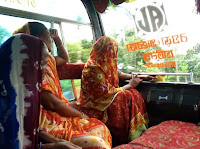
My first visit to rural Bangladesh was one of transportation: we rode countless buses, rickshaws, boats and walked on foot through paved streets, dirt roads, shallow rivers and mud puddles. We were definitely transported to another side of Bangladesh being outside of Dhaka, so it was fitting that we did nothing but use transportation to entertain ourselves: just looking out the window is a cultural experience.
I visited my friend Maude in the town Gaibandha, in the northwest state Rajshahi. She will be working with the French NGO, Friendship, and interviewing young students from a new project they started. The six-hour bus ride was certainly a trip – I might have lost hearing from the pleasure the driver took in honking the horn. But it might have been necessary, because he liked to drive on the right side of the road (which is the wrong side of the road here) to pass the sluggish trucks full of bananas, jute or chickens.
Friday is the weekend, the only day-off the whole week. But most stores are closed, then most restaurants are closed for Ramadan, as are the museums. As women, we are not allowed to visit mosques – so what is there to do in Northwest Bangladesh?
Well, quite frankly, nothing. But Maude and I decided we did not travel here to sit in the NGO office alone. We hopped on a two-hour bus to the town Mahasthangarh (still having trouble pronouncing it myself.) We were dropped off at a mosque then wandered down a road to the museum to discover it was closed. The road was beautiful: lined with rice pattys blowing in a soft breeze. It was so quiet that we could hear the wind, something lost in the madness of Dhaka.
After discovering there was nothing more to do in Mahasthangarh besides breaking rocks with other rocks, we hopped on another bus to a ‘bigger’ town, Bogra. It was after noon at this point and we haven’t eaten all day with all the restaurants closed. But after breaking through the swarm of bus hustlers asking, “kothay jabe?” (‘where are you going?’), we found a hotel for foreigners that had a restaurant. We enter sweating, and smile in the breeze of the fans and in the soundlessness of the lobby away from the hustlers – then the electricity goes out.
We wait 40 minutes for the fan and our food, but Maude and I are super chatty so it went fast. And luckily, in the hour we took for lunch, it began then ended the daily rain. We talk to our waiter about what there is to do in Bogra: "Nothing," he responds. “Go to Sariakandi and take a boat ride around the river for 50tk.” Why not?
Hopping on to rickshaw, we swerve through Bogra into another city for 20 minutes then stop at a bench. “Bus station.” We sit on the bench and ask the ticket man when the next bus to Sariakandi is coming: “Five minutes.”


Twenty-five minutes later, there are a constant horde of about two dozen Bangladeshi men standing around, sometimes so close I can feel the air from their open mouths, staring in curiosity. None of them try to talk to us. I try to talk but they just stare. Their dialect is different and can’t understand me. I try to make them leave, but they just laugh. Finally the bus came.
Onto another bus ride, which by the way - women usually sit in front. Mostly to avoid harassment. After sitting on the back of the bus at one point, I learned my lesson never to sit in the back ever again. We arrive at another town, and the rickshaw-wallah takes us to the river. Now we are in a village, with naked little boys running around, hitting each other with sticks, avoiding their mothers screams not to step on the drying dates in the middle of road.
We arrive at the river and the first thing we notice: no noise. No motors, no yelling, no piercing radios blasting Bangla music. We only attract a small crowd, of about 15 people and we turned our backs to the land and stared into the river – so we almost felt alone. We “spoke of many things, fools and kings,” and watched a man try to catch tiny fish with a five-foot long U-shaped net.
Realizing our skin is beginning to burn (the woes of being white in a country where its people don’t sunburn), we head back to the bus stop, which is a bench. A crowd gathers, and we count: 47 people at one point. In order for us to keep our cool, we make jokes: “We’re like monkeys in a zoo: they can’t communicate with us, but they just watch how we sit and look. Go get a banana, and you can feed us! We should start charging them like a zoo: 100tk to stare. For 500tk, take a picture. For 1000tk maybe we’ll smile. Buy us some food, and maybe we’ll do a dance. Or, maybe I should just start foaming at the mouth and try to bite them, will they go away?”
One man came over to shoo everyone away. I smiled softly at him and said, “onek dhonobad (many thanks).” He smiled sympathetically. After a minute of pushing everyone away, more people surrounded us after wondering why a man was shooing everyone away. Mission quiet time: futile. At least having so many people stand over you blocks out the sun and her harmful rays…
It’s now evening, almost the end of today’s fast. We stop around dusk for all the men to get off and smoke their first cigarette since the morning. Maude and I bolt off the bus to find some food and water – sweet relief! It’s hard to not eat the whole day, but it’s even worse when you are in a climate that you are not accustomed too. The weather is so hot and we become so dehydrated. In trying to be respectful, I never try to eat or drink in front of Bangladeshis who are fasting, but it’s hard to find quiet place alone when everyone follows you like celebrities (without body guards).
Around 8, we’re back in Gaibandha. The town is beautiful at night – no cars on the road, just motorbikes and rickshaws and a few buses. We pass all the stores open for the night, lit by candle. We find our way home by the torch on my cell phone, walking through the sounds of geckos and frogs, running past the growling stray dogs. Finally, as Maude digs through her bag to find the key to the NGO’s office (where we are sleeping), I stand out from under the verandah and for the first time, see the stars from the view of Bangladesh.
Wednesday, August 12
Chittagong Hill Tracts: Dancing Against Genocide
However, there is little information available describing the situation in the Chittagong Hill Tracts (CHT). Gladly, this festival gave myself and my fellow travelers some insight.
Walking about with our new friend, we gazed over the beautifully patterned clothing. Dhaka dress is much more flowery than the traditional clothing of the hills where the patterns were more geometrically shaped. It was also interesting to see new faces at the festival. Most of the tribes are Buddhist and look more Chinese and Burmese than Bengali. Our friend said that many Bangladeshis think he is a Chinese businessman, and said he loves the look on their faces when he speaks to them in Bangla slang. He also sympathizes with us foreigners who are always charged more for fruit and rickshaw rides!
He bought us small pamphlets describing the political and social history of CHT. Briefly, because of the location, CHT is a very valuable natural resource. And what happens when governments get a hold of valuable resources? Tribes are evicted, violently, and the people have had little to no rights. The past ten years have been under a Peace Treaty but an unrecognized genocide remains in the past and constant fear of aggression for their future. Visit here for more information.
We toured around, sat under palm trees and chat. The French girls are studying microloans – really interesting things to say, a relevant topic to dive into, thinking about women after trafficking. After a bit, we headed inside into the auditorium to watch indigenous dance performances. (Visit again in a few days, a short video will appear.) I think dancing is the most immediate of human connections, and my favourite way to learn about other cultures, and exchange with locals. Dancing always breaks the embarrassment barrier in the presence of a new person. Just showing off moves, and learning new ones creates this instant connection, where you laugh at each other’s mistakes and smile when you nail a move. It was an incongruous feeling: to be at an event concerned with an unrecognized genocide, a complete dehumanizing and alienating experience -- but to be watching these magnificent dancers, feeling a deep, instinctive connection through the beats of their feet. That's life I suppose: a conflicting ride of experiences and emotions that all, somehow, balance in the end -- if you look for it.
Even though there weren’t any more seats, and I was sitting on the suspension bar of a broken seat, I was beaming at the divine humanity of these light-footed women moving in their jubilant attire under lurid lights.
Tuesday, July 28
"Biggest Development Site": First Day Part II
After class, I drop off some paperwork to the principal and ask her where I can go buy some new salwar kameezes. I only have three cotton ones, and my dry cleaning takes time. She told me to wait. I wound up reading a magazine that mentions a Fulbright Scholar from Bangladesh going to America for Human Rights laws – his speciality: working on the big Trafficking in Persons report. What luck! I emailed my Fulbright advisor who gave me his email. I'm waiting to hear back - cross your fingers! (BTW, read the proposal to my research here. Soon I will write a shorten version.)
While waiting for Susan, I talk with Julian, a man from New Zealand. He has been working in Bangladesh for seven years with a Baptist organization that promotes community building and development. He said, “Dhaka is the biggest development site in the world.” Perfect for my project: hopefully many groups to choose from. I told him my project and we started talking about gender inequality. Then he said something really interesting:
“Our goal was to get 50-70% to come to our different development workshops. For our first workshop, there were 95% women. I thought we exceeded expectations. Then someone told me that 50-70% women was hard, because it is hard to get men involved. Unfortunately, that is where the change is. Because men are still dominant decision makers here, it is more important to have men present as well as women. The more men involved, the more the group will be respected and have power to create legitimate change.”
He said that this wasn’t to say that women aren’t welcome, but for these development seminars and groups, increasing the percentage of men is essential to combating not only gender inequality, but in creating local change. According to UNICEF: State of the World's Children 2007, only 3% of property owners are women in Bangladesh, therefore men are still the decision makers of households and women have little power to step in with new knowledge and change things, like poverty or child mortality (watch this awesome video called The Girl Effect.)
It is definitely something to think about for my project.
After a little bit, Susan came out and said ‘Challo’ (let’s go.) She decided to come with me and take me to her favourite shops around the area! Ki mishti (how sweet), and she would grab my hand whenever we crossed the street. I’m not sure if it’s a cultural thing or she thinks I’m dim. But I was grateful.
We window shopped for about an hour chatting about family and our cultures. These stores were of middle class price. Not too expensive, she said, but good quality. The most expensive one I bought was $21 – includes the dress, the pants and the scarf (I wondered to myself for such a hot country, there is an awful lot of material.) One thing I noticed was the mannequins: they were all white, most with blue eyes, and much taller than the average Bangladeshi woman. Basically, I looked more like the mannequins than the locals did. I asked Susan why, she said, “Light skin is beautiful.” I’ve mentioned before in other blogs from different Asian countries (China, Thailand, India) that there is cream available to lighten your skin: a self-whitener (the opposite of a self-tanner.) Watch the video below:
It's frustrating because my friends and I in America lay outside, risking to develop skin cancer, to appear darker; here they yearn for lighter. Corny, but why can't we just be happy with the skin God/Allah/Ganesh/our mother gave us? Grass is always greener, man, always greener.
One more installment tomorrow!