
then this happens: Bangladesh Government Bans Facebook
Showing posts with label news. Show all posts
Showing posts with label news. Show all posts
Saturday, May 29
The Power of Government Destroys Youth's Little Freedom...
I re-joined the goddamn social networking site to keep in touch with Bangladeshi friends...

Monday, February 15
Wednesday, November 11
Journey by Emma Thompson
Update 11/16: My amazing friend Jika Gonzalez went to see Journey, here's her entry on it:
Monday, November 9
South Asian Education and Development: Rooted in Histories
From missing internet for a dreadful two whole weeks (half sarcasm noted), I missed some news and good articles. Thanks to Neelofer, she sent me Nicholas Kristof’s article, “More Schools, Not Troops.”

Now, I debate with myself over Nicholas Kristof and the sincerity and authenticity of this work. This article was one of disappointment.
I can agree with Kristof’s overall point: a message to the US government to stop bombing countries and start to develop them by providing schools. This is one of the best ways to bring recurring, deep change. He brought up Greg Mortenson, a humanitarian I have mentioned before who has pioneered building schools in Pakistan and Afghanistan with his bare hands (not an expression, actually true.) Kristof noted that these schools are secular and are not being threatened and are welcomed by the community. Rich Islamic extremists are building schools that teach solely radical Islam, which end up being the only outlet for poor families to give their children an education. If extremists are investing in the youth to spread a particular message, can’t we start to invest in schools to spread a more secular message?
Then Kristof compared Pakistan with Bangladesh. First off, not a good idea. The two nations may have been one 50 years back but that in no means allows for a comparison: the Pakistan of 1947-1971 was forced by the British, nations separated by their enemy, India, speaking separate languages with differing cultures and economies. These differences lead to the Liberation War making Bangladesh it's own country. Pakistan is to Bangladesh as the US is to Nicaragua. To this day I don’t know how India survives with it’s own diversity.
Kristof makes the comparison that Bangladesh focused on education since becoming it’s own nation in a way that Pakistan never did. But Bangladesh received more help than Pakistan. Bangladesh was the poster-child of a desperate nation so much so that George Harrison along with Ravi Shankar held a concert in New York in 1971 to send money through UNICEF. No one did that for Pakistan. Also, Bangladesh has become the ‘development capital of the world’—education not the only focus but providing medical, social and environmental services. Education will do nothing if the current surrounding society isn’t improved. Kristof then claimed that, “Bangladesh now has more girls in high school than boys.”
At first I wondered how accurate of a statistic this is (it was not referenced). Looking at UNICEF, it seems that Bangladesh is a forerunner in achieving equality of gender enrollment in schools. Enrollment is one thing; attendance and continuing education are another--25% of Bangladeshi girls don't actually finish their primary school education according to UNESCO 2007. Kristof then says that “those Bangladeshi women joined the labor force, laying the foundation for a garment industry…” Educated women do not go into the garment industry. This industry is one of mostly unskilled labor for the most part so much so that children can work there.

The next day, I mentioned the article to an amazing friend; his father is Burmese, and his mother Persian, they met in Chittagong, Bangladesh then moved to New Jersey. He speaks English, Bangla, Urdu and local Chittagong language. He agreed, and shared some of his insight by mentioning how Bangladesh is very homogeneous: everyone speaks the same language (though dialects) and it is a very small country where it is easy to travel (via river or over the land which is mostly flat). Also add into the fact that Bangladesh fought for their country: an instant camaraderie existed as all Bangladeshis fought behind Bangabadhu for their language and culture. It was their choice and their families and neighbors as one.
Pakistan, even Afghanistan, are quite heterogeneous where communication between tribes is difficult over endless hills, too much desert and a myriad of languages. Perhaps now Afghanistan and Pakistan are uniting in their own countries—but at the rate we’re going it’s going to be in hatred against us.
While I support Kristof’s, I urge him not to compare too much two different societies. Of course, use one as an example but take into account the different histories that lead to the differences that exist today.
Tuesday, November 3
With Privilege Comes Responsibility: The Case of Corrupt Governments
I’ve been thinking about superheroes stories. In all the comics, movies and tales, when one is given extraordinary powers, they either execute them for good or evil. Obvious that those who choose to use their new power for evil do so to gain more power over those who are weaker—a pathetic and unsophisticated way to spend your time here on Earth. What interests me more is the urge of responsibility heroes like Superman and Spiderman felt with their power. Their superpowers are a privilege, an obvious advantage over the rest of the human population. With this privilege, they felt an overwhelming responsibility to protect and spread their privilege.
Note the word ‘superpower’ and think about today’s politics...
A story meriting little mention to the world was an assassination attempt here in Dhaka a couple of weeks ago. The attack was aimed at Fazle Noor Taposh, a lawmaker and nephew of the Prime Minister of the Awami League party Sheikh Hasina; only 13 people were reported to have been wounded.
I was told this the morning of my last day of Bangla class. My teacher Pulok revealed the story to Hiroto and I. Somehow I brought up the corruption of the Bangladesh government, listed to be the second most corrupt government in the world according to Nation Master. I began to argue that the Bangladeshi people kept the government corrupt by electing the same officials and politicians who don’t do much for citizens.
“How can we elect new politicians when you can’t become a politician without money?" said Pulok-Da. "The same people keep getting reelected because it’s the same people who have all the money.” It’s something I’ve noticed too; there is a very small middle class in Bangladesh, mostly living in Dhaka. And when they are poor – they are destitute. When they are rich – they. are. RICH! I’ve seen Escaldes almost flatten beggars on Mirpur Road.
Pulok-da went on to say that it is up to America to end corruption in government (and other Western governments, but we’ll use America as the example because the world DOES use us as an example: we are both the lock and the key to the worlds problems.) “It’s up to America to put pressure on our government to change her ways of corruption. America has already done that with Islamic fundamentalism—and it’s working! Believe me that there are less violent uprisings and radical groups than a few years back. A lot of it has to do with the money America gives to us to suppress these radical regimes, and the investigations to confirm the money is spent to end these violent ideologies. If America would only do the same for our corrupt government, maybe we would get somewhere.”
I stated that yes, external pressure from governments does have some effect (i.e. South Africa’s apartheid), but pressure has to come internally—from the people themselves. Pulok-da looked up and said, “With what rights? This is not a democracy, only a façade. I have no say. The police can arrest and frame me for anything. If Obama’s daughter committed a murder, she would be jailed, she is not protected just because she is a VIP. But here, if Sheik Hasina’s cousin did the same, he would be protected. Even with my job, I have to listen to everything my boss says. If he said to walk from my house to my work, a trip of over 4 hours, I would have to. I risk losing my job if I ever disobey and how will a find another? You must listen to your boss in the US but you have rights and you can argue and still keep your job. If you were unlawfully fired or hurt, you can seek retribution. We can’t argue here. No, we need you.”
America’s superpower is that of voice—the freedom and the protection of our voices. Let’s think clearly of how we are going to decide to use it. Unlike other superheroes who didn’t ask for their privilege, we created our superpower and with it our responsibility.
Life is always more complicated than a comic strip, but perhaps our principles can be more simplified...
Follow-up: Response to Nikolas Kristof's Op-Ed
Friday, October 9
Bangladesh's Future Rests on Development of Ethical Financial Markets
Article by fellow Fulbright Scholar, Dr. Parvez Ahmed
A good article to understand the markets and ethics (or lack-thereof) of Bangladesh.
Thursday, September 17
Sexual Harassment: Is separate space helping to integrate the sexes?
The above article discusses how in India, there are now separate train cars for 'ladies only' to commute due to the sexual harassment that occurs from their male peers.
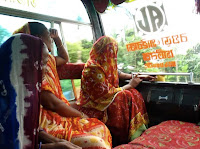
Believe me, I understand what they're feeling. In some Bangladesh buses, the front seats are saved for women. A few weeks ago, I sat in the back of a bus for the first time and was groped by a man; actually, a man who worked for the bus. I smacked him hard on the head but that, of course, changes nothing. I argue to sit in the front of the bus from now on to avoid harassment...
But I question: is creating separate space harmful or helpful when you are trying to integrate the sexes into the same space? The title is misleading, saying that there is "new peace" -- but the article goes on to discuss how men are harassing the women more, even defecating on the ladies' train to show disapproval. Men are not happy - why? Because their power is being taken away, of course. Now not only can women get jobs, but now they are encouraged because they can feel comfortable commuting on these new trains.
Until recently, I've played devil's advocate by supporting the hijab, the Muslim head scarf. I frequently recite something a female friend from Malaysia told me:
"When I was of age, my parents started making me wear the hijab. I hated it, oh it was the worst. I used to go to the mall with my friends after school and we'd rip off our hijabs and let our hair flow free. But as I got older, I started to understand what it meant. It wasn't to cover me up, but to protect me. There are a lot of bad people out there, and they know that I am a woman of Allah. It's like Christians wearing a cross around their neck to show their beliefs..."
I'd share this in my Women and Gender Studies classes, saying that after living in India, sometimes I just wanted to cover up too, hide my body so I won't be harassed. It is common to say that women should cover up in order not to tempt men into committing sinful deeds, like harassment or rape. My female friend in Malaysia said that they feel more protected from the eyes of dirty men in their hijab. Outside of religious context, I compare the 'ladies only' trains to the wearing of the hijab for the purpose of protecting women from wandering eyes and hands.
But is hiding and protecting going to change the attitude that it is alright for men to inappropriately touch women? Is wearing a hijab going to stop a man from realizing you have breasts that he could grope? Is keeping all the women at the front of the bus or in separate cars suddenly disintegrate their immoral desires? Instead of separating women, shouldn't they be teaching men to withhold and destroy these desires? When did hiding or running away from the problem actually solve it?

What needs to happen is an attitude change: a change in the male perspective from aggression to acceptance and understanding of the positive effects of women empowerment. I've read articles of both Western and local women and men giving lectures about positive aspects of women's empowerment to men. I've read signs placed in public spaces by the government and NGOs declaring the value of women's housework. But how often is our life changed by reading a sign during traffic?
One major problem I believe is implementation via the police. The NYT article states that violence against women as increased: "Between 2003 and 2007, rape cases rose by more than 30 percent, kidnapping or abduction cases rose by more than 50 percent, while torture and molestation also jumped sharply." A story is told about a woman who was beat by her husband for having a Western haircut. What happened to the husband? Did he do what is commonly done and pay off the police and got off scot-free?
The government is in favor of women's rights and empowerment, clearly stated in their order to universities to allow women to wear jeans, though the universities consider it 'indecent.' The government funded the 'ladies only' trains in an effort to allow women to take outside jobs. But, how often does the government force implementation on the rights violations of women? How often are men imprisoned for rape and assault against women? The violent acts are increasing, is imprisonment increasing at the same rate?
If Indian women, and the government they vote for* are making the decision to step outside the home and break down traditional patriarchal structures, hiding in private cars and under loose clothes will not change inherent animosity from those who take stock in patriarchy. The women and it's government must be prepared to fight and show that this isn't temporary. They must not stand silently during harassment, and the government should prove that it will not stand for the increased violence that occurs. They must prove that this change is not temporary.
*India is the world's largest democracy.
And thanks, Courtney Parks, for sending me this article!
Subscribe to:
Posts (Atom)


 Posts

