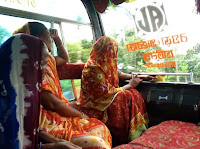
This entry is long overdue but I had difficulty deciding what to say. The title of this entry in Bangla means “women empowerment.” It’s a topic often forgotten, usually lost and sometimes thought unnecessary and discriminatory. It is too deep a topic to dive into for one journal entry – but it is my life’s work. It is still an issue in every country, including America – but for now I will focus on Bangladesh.
- On the Gender Development Index, Bangladesh was ranked 120 out of 154 in 2007
- BD is one of the top ranked countries that seclude and restrict its women (HRW)
- The average age of marriage is younger 20 years, most likely not by choice but by parents, mainly father’s, choice ( )
- 50% of women have said they have experienced physical abuse by male partner. In 2002, 68% of Bangladesh women never spoke to family or officials about their abuse (WHO, HRW, AI) Only about 4,100 rapes are reported each year – this might be due to the silencing of women, as well as the fact that there is no law acknowledging marital rape. (WHO, UNIFEM)
- Honor killings regularly occur, and 50% of all murders in Bangladesh are of women by their husbands (US Dept of Justice, HRW)
- Because sons are still strongly preferred than daughters, 1.6 million girls are missing (missing means that by average, there would be more daughters in families if this discrimination didn’t exist. Instead, they are missing, meaning killed, aborted, sold or not given proper medical attention or food.) (UN, US Census Bureau)
- 85% of assembly line workers are women. Factories demand unskilled labor at miniscule salaries – girls are less likely to have an education so they provide the unskilled labor for little pay.
- More than 25% of young girls don’t finish their primary school education compared to the 10% of boys. In universities, only about 35% of students are female. And only 15% of primary school teachers are women. 59% of women are illiterate compared to men’s 46% (UNESCO)
- Less than 5% of land owners are women due to widespread discrimination against women inheriting, owning or controlling property (ICRW)
Depressed enough? Hold your hats, I haven’t even dove into the stats of trafficking yet. But we’ll wait on that for another day.
In my two months here, I have met some amazing women. When selling Iftar on the street, no exaggeration, 99% of the customers were men. One women came to the table with a private car and beautiful purple sari. Striking a conversation with her, she revealed to me that she had three jobs: professor of psychology at Dhaka University, private practice in psychology, and a writer for a children’s television program (the Bangla version of Sesame Street!). I went to a lecture on Gender and Development at Dhaka University, the lecturer standing up there, confident and proud, arguing in favor of positive discrimination to a room full of men, with her daughter sitting on the side because no one was home to watch her. Enormous strides have been made in women’s rights, including the passing of an act to reserve seats for women in Parliament, more women are attending school and working alongside their husbands. Even one man proudly said, "Women can drive now!"
But, I have yet to see a woman driving here. Laws are changing, but cultural practices are deeply embedded and are slow moving. Empowerment is defined has the ability to make a choice, controlling life decisions and claiming rights. By law, women are claiming more rights, but on the street and in the villages, too many social pressures exist that keep women inside, silenced and devalued. Often, law enforcement official do not value or practice these laws.
But I will share one story that gave me hope: at the lecture on Gender and Development, the woman lecturer was stating that positive discrimination was needed to raise women to the power level of men. One example is on the crowded streets and buses that should reserve seats for women because men push women out of the way to get on the bus, and if she gets onto the bus, she is likely to be touched. One man argued against this, saying, "Of course on a crowded bus you will be accidently bumped. There's no need for special treatment."
Across the conference table, one of the 7 women in the room, wearing an hijab and quiet most of the night, leaned across the table and said, "I know the different between an accidental bump and a hand down my dress."
He shut up.
Women are speaking up. Voice is the first step towards empowerment: vocalizing your situation, hearing stories to organize and create real change. Just because Bangladesh has a woman Prime Minister, doesn't mean that governmental and structural changes reach the women who need it. These cultural changes have to start with the women themselves.
Today, I went with a fellow scholar’s family to the mosque for jumu’ah, Friday prayer. Though Muslims are to pray five times a day, Friday is the mandatory day for men to go to the mosque. I was dressed up by the women of the family in a long sleeved blouse with my orna wrapped around my head as a makeshift hijab. It was nice to blend in (for the most part) and not be gawked at for being foreign.
I joined Ms. Ahmed, her mother-in-law and her daughter in the section for women upstairs. It is not mandatory for women to attend Friday prayers at the mosque because Mrs. Ahmed said, "We have so many things to do, like care for the children." The khutba, sermon, was in Bangla mixed with Arabic but I was clued in. A few of the words that I kept picking out was ‘maph koren’ –forgive. The imam was reminding everyone that while asking for forgiveness, to remember to forgive yourself. The Ahmed family shared that this is why they come to mosque: it’s a time of the week to have reminders of what Allah has said. Today was a reminder to forgive yourself for whatever mistakes you made. It was personally a good reminder for me.
I arrived home to realize: it is September 11th. I think it was quite fitting that I spent an amazing afternoon with a beautiful, dedicated, welcoming and compassionate Muslim family. Admittedly, I have my questions and concerns about Islam, which is hard to escape when you read American news.
But the most important thing I learned today is that the Qur’an states that there is no compulsion in Islam: that you do not try to convert people, but let them read the Qur'an themselves. Only this way can you understand the true beauty. Too often are people listening to someone's flawed interpretation. Mrs. Ahmed shared that a lot of the challenges of Islam stem from individual, local cultural practices not the chapters of the Qur'an.
I am still looking for a Qur'an in English because I would like to read it myself. As any religion, it cannot be understood after one prayer session, but I cannot make this more clear: just as the terrorists on 9/11 should not have judged all Americans to be ignorant, immoral, malicious people, we should not judge all Muslims as the same.
**My fellow Scholar, Parvez Ahmed, wrote this article for the Huffington Post the day before we went to the mosque. Please take a look!
“They hung their heads in shame as their mother stood behind them, the end of their sari wrapped around their head and mouth, listening to their children’s grades read aloud to the entire village…”
Last Saturday my friend Maude was gracious enough to let me tag along to watch her work with her NGO. We hop on the back of her friend’s motorbike that takes us to the river. Maude turns to me and said, “Today we are going to a char to do interviews.” We climb onto this long wooden boat with a motor, bamboo roof and wicker mats to sit on.
“Oh, by the way, the trip is almost two hours.”
Staff from the NGO climb into the boat; one is able to speak English, Maude’s translator from the NGO. They all play card games or nap the whole trip, while Maude and I speak with the translator about Bengal politics and finance. At one point, the sun was hidden behind the clouds, so we head to the top of the boat. Quietly we pray that the bamboo will hold us and the three other staff members sitting on the roof under umbrellas. No worries – it did. And how refreshing: cool breeze, clean air, no noise or staring. Laying up there, I could breathe.
We drop off other staff members at different chars and we ended up at Sidai. The reason for Maude’s visit was to interview teachers and students about a ‘student-friend’ program the NGO started. A student from the school must tutor a child who doesn’t have the chance to go to school. Tutoring them enough should bring them up to speed to join school the following year. Maude needed to see how effective this initiative was by talking to teachers, students and the principal.
As we get off the boat, we must walk through mud barefoot, into shallow, murky water that almost reached my knees. The bottom the river was super slippery with mud and I kept slippin’ and slidin’ all over. We get on land, albeit not dry, but solid was all I could ask for. Walking through this little forest of skinny trees, the ground became less muddy the farther we got from the river.
Then the parade of children began to grow behind us the closer we became to the village. A couple, a few, several, a dozen, a few dozen… The children at least keep a safe distance from you. When we walk through, it’s like the parting of the Red Sea, opening in front and closing behind. But it’s a sea of little black and dusty faces.
“What is your name?” they ask. After my response, in their little accented voices, ‘Amanda’ is echoed back a few hundred times. Maude is speaking with the different staff about the project for the day, while I try to play with the children. ‘Try’ being the operative word because it’s so hot I can barely breathe. Plus, I don’t want to drink water in front of a crowd of people who 1) can’t keep their eyes off of me and 2) are fasting. Ramadan rules my life.
Maude invites me to sit in on her interview with a teacher about the “student-friend” program. A vital part of interviewing is having a good translator: who understands what you are trying to accomplish, and does not have anything invested in the project. Maude’s translator was sweet, but because he works for the NGO, he often answered the questions himself without asking the interviewee. At one point, a question was asked to the principal who responded, “jani na” – I don’t know. The translator turned to Maude and answered the question himself. Maude knew enough Bangla to know the response was “I don’t know.” She said to me, “How am I supposed to help them improve the program if they won’t tell me the truth about how it works? If they don’t know an answer or are frustrated with something, I need to know so we can fix it.”
Bangladesh is one of, if not the, center of development. There is a mammoth amount of foreign aid pouring into the country as well as development projects and programs. The biggest NGO in the world is Bangladeshi: BRAC. And from my experience, Bangladeshis are very nationalistic, very proud of their culture and country, regardless of its shortcomings (like poverty and corruption). I found that talking to Bangladeshis here, they only share what they love about Bangladesh, rarely what they dislike. Other countries I’ve been to like India, Japan, Italy; the citizens will give a well-rounded view of their country – the pluses and minuses. But as a foreigner here, I am only lectured on the golden qualities of Bangladesh.
I wonder if this overwhelming pride is shared with me because most people assume (rightly so) that I, a foreigner, am here working on a development project. So many foreigners are coming in to discuss all the problems and things wrong with Bangladesh, trying to ‘fix’ her: from labor rights to how they should kill their chickens. Constantly they are put on the defense about their culture (especially their religion) attempting to shed a good light to people who often see the dark side. Their patriotism is reasonable.
But from a development perspective, NGOs seek the terrible stories in order to develop. The reality and truth must be shared, no matter how embarrassing or tragic it is. For Maude, it was vital for her to hear the reality of the program: what worked and what didn’t. Money is hard to come by for NGOs and it’s better to know that it’s being spent on effective, positive and well-liked projects than a project that is dispensable. Tough choices have to be made. She also understood that it is difficult to come to a char for the first time demanding answers. It’s intimidating. As someone working to create change, you have to know the people, have them trust you – so you can trust them that they will give helpful, truthful responses.
It’s slow, which is frustrating because funders want results – fast. Destruction is easy, development is slow.
Later, we had the chance to sit in on a parent-teacher conference. And by parent-teacher conference, I mean a conference with most of the parents and all of the students, and a few of the teachers. The leaders of the NGO read all grades aloud to everyone. Everyone clapped for the students who received 100s across the board. One NGO leader turned to me a few times when some boys were called, saying “There goes the next President Obama!” I know it was said in pride of the student, certainly, of course - but no girl was remarked as being the ‘next Hilary Clinton’ or even their own Prime Minister, Sheikh Hasina. Girls are still devalued, but that's my next entry...
The student who failed and were lowered in rank – they hung their heads in shame as their mother stood behind them, the end of their sari wrapped around their head and mouth, listening to their child’s shortcomings said aloud to the entire village. The leaders of the NGO end with: “You should pay more attention to your child and their school activities.”
I sat there in the heat, burning at this NGO. I don’t think competition is ever a good way to teach children. Instead of competing with other students in the village, the child should work and be pushed to the best of his abilities. Unfortunately, it is about 99% sure that these children aren’t going to grow up to be the next Prime Minister, or even a political leader. They live in a village surrounded by water with little electricity and a school that just arrived three years ago. It’s not negative -- it’s reality. Instead of them competing for first rank and grades, they should just be learning to improve their quality of life by reading and writing. The first place to start is by not announcing grades aloud, because both the children and parents were humiliated in front of their friends and neighbors. One-on-one meetings are much more effective: the teacher, who knows the student, can talk to the parents about their child’s progress: both positives and negatives; not a NGO leader who stops by a few times a month.
Also, the NGO was telling parents, “pay more attention to your children.” Let’s think about this: do you honestly think that the parents, after sitting in a hot room for two hours, half of them embarrassed that their child did poorly, will actually go home to ask their children about their day, because some man told them to in a lecture?
One-on-one meetings again are effective, because the teacher can sit down with the parents and find out how their home situation is. Maybe little Ahmed is sleeping in class and failing because his father lost his job so little Ahmed works after school while his parents scramble to find work at night, leaving little Ahmed to watch two other siblings because his mother can’t afford birth control. A large meeting could not discover this – you must be one-on-one with a person to understand their needs, the reason for their needs and the capacity they have to do something about it, and what role you can play.
I can’t blame the NGO for these shortcomings. Too often do development programs fail not because they were ineffective, or they had bad leadership – but because funding is lacking. A lack of funding leads to a lack of capacity so unfortunately, it might not be feasible for this NGO to perform one-on-one meetings because they can't afford to pay overtime to the staff that might be overworked.
What's shameful: I hear that because there is not much structure here in Bangladesh and no follow-up or registration, some NGOs exist for profit with a façade of charity. Maude told me that one NGO built a well right next to another well in one village just to state on their Annual Report that they ‘provided a new clean well for a village up north.’ It was a façade to boast for funding, but utterly useless to the village who already had a well.
It’s a tricky business, which is unpromising because so much good could be accomplished with development research and studies -- it shouldn’t have to be a business.